-
Mayur Vihar 3 Delhi, 110096 India
Paid Course
Class 12 Geography Chapter 1 Human Geography Nature and Scope (Manav Bhugol) Important Questions Answers
Class 12 Geography Chapter 1 Human Geography Nature and Scope (Manav Bhugol) Important Questions Answers
Course Overview
Class 12 Geography Chapter 1 Human Geography Nature and Scope (Manav Bhugol) Important Questions Answers
Class 12 Geography – Chapter 1
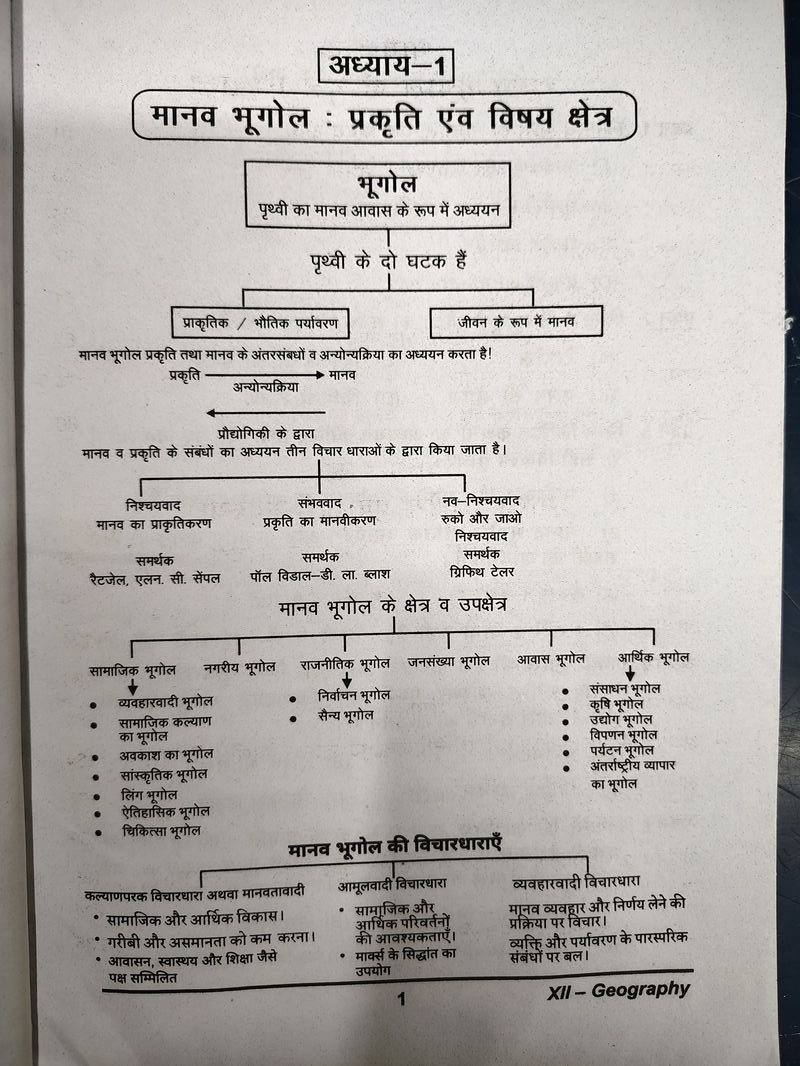
मानव भूगोल : प्रकृति एवं विषय क्षेत्र
### Human Geography: Nature and Scope
नीचे आपके दिए गए पूरे प्रश्नपत्र को हिंदी और अंग्रेजी दोनों भाषाओं में प्रस्तुत किया गया है। इसमें MCQs, लघु उत्तरीय प्रश्न और दीर्घ उत्तरीय प्रश्न शामिल हैं।
### PART A – भाग अ
### Multiple Choice Questions (1 Mark Each)
### बहुविकल्पीय प्रश्न (प्रत्येक 1 अंक)
Q1. Which of the following is NOT an approach to Human Geography?
निम्न में से कौन-सा मानव भूगोल का उपागम नहीं है?
(A) Exploration and Description / अन्वेषण और विवरण
(B) Postmodernism in Geography / भूगोल में उत्तर आधुनिकवाद
(C) Regional Differentiation / क्षेत्रीय विभेदन
(D) Humanisation of Nature / प्रकृति का मानवीकरण
Q2. Which of the following geographers is associated with Possibilism?
निम्न में से किस भूगोलवेत्ता का संबंध संभववाद से है?
(A) Ratzel / रैटजेल
(B) Vidal de la Blache / विडाल डी ला ब्लाश
(C) Ellen C. Semple / एलन सी. सेंपल
(D) Griffith Taylor / ग्रिफिथ टेलर
Q3. Study the following statements and choose the correct option.
निम्नलिखित कथनों का अध्ययन कीजिए तथा सही विकल्प चुनिए।
1\. Physical Geography studies the physical environment. भौतिक भूगोल भौतिक पर्यावरण का अध्ययन करता है।
2\. Human Geography studies the relationship between the physical environment and the human world. मानव भूगोल भौतिक पर्यावरण और मानवीय जगत के बीच संबंधों का अध्ययन है।
(A) Only 1 is correct / केवल 1 सही है।
(B) Only 2 is correct / केवल 2 सही है।
(C) Both 1 and 2 are correct / 1 और 2 दोनों सही हैं।
(D) Neither is correct / दोनों में से कोई सही नहीं है।
Q4. Who defined Human Geography as "the study of the changing relationship between the unstable Earth and the active human being"?
मानव भूगोल की इस परिभाषा का संबंध किस भूगोलवेत्ता से है – "मानव भूगोल अस्थिर पृथ्वी और क्रियाशील मानव के बीच परिवर्तनशील संबंधों का अध्ययन है।"
(A) Huntington / हंटिंगटन
(B) Ellen C. Semple / एलन सी. सेंपल
(C) Vidal de la Blache / विडाल डी ला ब्लाश
(D) Griffith Taylor / ग्रिफिथ टेलर
Q5. In the early stages of development, humans listened to nature, feared its fury and worshipped it. Which school of thought does this statement support?
विकास की आरंभिक अवस्था में मानव प्रकृति की सुनता था, उसकी प्रचंडता से भयभीत था और उसकी पूजा करता था। यह कथन मानव भूगोल की किस विचारधारा का समर्थन करता है?
(A) Environmental Determinism / पर्यावरणीय निश्चयवाद
(B) Possibilism / संभववाद
(C) Neo-Determinism / नव-निश्चयवाद
(D) Behavioural Approach / व्यवहारवादी विचारधारा
Q6. Which of the following is NOT a branch of Human Geography?
निम्नलिखित में से कौन-सी मानव भूगोल की शाखा नहीं है?
(A) Urban Geography / नगरीय भूगोल
(B) Population Geography / जनसंख्या भूगोल
(C) Economic Geography / आर्थिक भूगोल
(D) Physical Geography / भौतिक भूगोल
Q7. Geographer Griffith Taylor is associated with which school of thought?
भूगोलवेत्ता ग्रिफिथ टेलर का संबंध किस विचारधारा से है?
(A) Environmental Determinism / पर्यावरणीय निश्चयवाद
(B) Neo-Determinism / नव-निश्चयवाद
(C) Possibilism / संभववाद
(D) Positivism / प्रत्यक्षवाद
Q8. Study the following statements and choose the correct one.
निम्नलिखित कथनों का अध्ययन कीजिए तथा सही कथन का चुनाव कीजिए।
(A) Geomorphology is an important branch of Human Geography. भू-आकृति विज्ञान मानव भूगोल की महत्वपूर्ण शाखा है।
(B) Ratzel propounded Neo-Determinism. रैटजेल ने नव-निश्चयवाद की विचारधारा का प्रतिपादन किया।
(C) Technology is an indicator of the level of cultural development of a society. प्रौद्योगिकी किसी समाज के सांस्कृतिक विकास के स्तर का सूचक होती है।
(D) Large-scale urban expansion by humans is an indicator of Determinism. मानव द्वारा विशाल नगरीय प्रसार निश्चयवाद का सूचक है।
Q9. Which of the following is NOT a source of geographical information?
निम्नलिखित में से कौन-सा भौगोलिक सूचना का स्रोत नहीं है?
(A) Accounts of exploratory voyages / खोज यात्राओं के विवरण
(B) Ancient maps and diaries / प्राचीन मानचित्र एवं डायरियाँ
(C) Rock samples obtained from the Moon / चंद्रमा से प्राप्त चट्टानी नमूने
(D) Ancient epics / प्राचीन महाकाव्य
Q10. Which approach emphasises the use of sophisticated statistical techniques?
निम्नलिखित में से कौन-सा उपागम परिष्कृत सांख्यिकीय विधियों के प्रयोग पर बल देता है?
(A) Regional Differentiation / क्षेत्रीय विभेदन
(B) Regional Analysis / प्रादेशिक विश्लेषण
(C) Spatial Organisation / स्थानिक संगठन
(D) Exploration and Description / अन्वेषण और विवरण
Q11. Who defined Human Geography as "a synthetic study of the relationship between the physical laws governing the Earth and the living beings inhabiting it"?
निम्नलिखित में से किसने मानव भूगोल को पृथ्वी को नियंत्रित करने वाले भौतिक नियमों तथा इस पर रहने वाले जीवों के मध्य संबंधों के अधिक संश्लेषित ज्ञान से उत्पन्न संकल्पना के रूप में परिभाषित किया?
(A) Ratzel / रैटजेल
(B) Ellen C. Semple / एलन सी. सेंपल
(C) Paul Vidal de la Blache / पॉल विडाल डी ला ब्लाश
(D) Griffith Taylor / ग्रिफिथ टेलर
Q12. Which school of thought is concerned with various aspects of human social welfare?
निम्नलिखित में से किस विचारधारा का संबंध लोगों के सामाजिक कल्याण के विभिन्न पक्षों से है?
(A) Behavioural Approach / व्यवहारवादी
(B) Humanistic Approach / मानवतावादी
(C) Radical Approach / आमूलवादी
(D) Utopian Approach / कल्पनादर्शी
Q13. The network of transport is generally described as which of the following?
परिवहन के जाल को प्रायः निम्नलिखित में से किस रूप में वर्णित किया जाता है?
(A) Respiratory System / श्वसन तंत्र
(B) Arteries of Circulation / परिसंचरण की धमनियाँ
(C) Blood Circulation / रक्त संचरण
(D) Cardiac Circulation / हृदय संचरण
Q14. Arrange the following approaches in ascending chronological order.
निम्नलिखित उपागमों को समय के आधार पर आरोही क्रम में व्यवस्थित कीजिए।
I. Regional Differentiation / क्षेत्रीय विभेदन
II. Spatial Organisation / स्थानिक संगठन
III. Exploration and Description / अन्वेषण और विवरण
IV. Regional Analysis / प्रादेशिक विश्लेषण
(A) I, II, III, IV
(B) IV, III, II, I
(C) III, IV, I, II
(D) II, I, IV, III
Q15. Match Column I with Column II.
कॉलम I का मिलान कॉलम II से कीजिए।
| Column I – Sub-fields of Human Geography / मानव भूगोल के उपक्षेत्र | Column II – Allied Social Sciences / सहयोगी सामाजिक विज्ञान |
| ------------------------------------------------------------------ | ----------------------------------------------------------- |
| (a) Behavioural Geography / व्यवहारवादी भूगोल | (i) Sociology / समाजशास्त्र |
| (b) Cultural Geography / सांस्कृतिक भूगोल | (ii) Epidemiology / महामारी विज्ञान |
| (c) Gender Geography / लिंग भूगोल | (iii) Psychology / मनोविज्ञान |
| (d) Medical Geography / चिकित्सा भूगोल | (iv) Anthropology / मानव विज्ञान |
Options / विकल्प:
(A) (a)-(i), (b)-(ii), (c)-(iii), (d)-(iv)
(B) (a)-(iii), (b)-(iv), (c)-(i), (d)-(ii)
(C) (a)-(iv), (b)-(iii), (c)-(ii), (d)-(i)
(D) (a)-(ii), (b)-(i), (c)-(iv), (d)-(iii)
Q16. Geographers of which country describe the State or country as a living organism?
निम्नलिखित में से किस देश के भूगोलवेत्ता राज्य/देश का वर्णन जीवित जीव के रूप में करते हैं?
(A) Germany / जर्मनी
(B) Britain / ब्रिटेन
(C) France / फ्रांस
(D) America / अमेरिका
Q17. Which of the following pairs is NOT correctly matched?
निम्नलिखित में से कौन-सा सुमेलित नहीं है?
(A) Friedrich Ratzel – Environmental Determinism फ्रेडरिक रैटजेल – पर्यावरणीय निश्चयवाद
(B) Ellen C. Semple – Welfare Geography एलन सी. सेंपल – कल्याणकारी भूगोल
(C) Griffith Taylor – Neo-Determinism ग्रिफिथ टेलर – नव-निश्चयवाद
(D) Vidal de la Blache – Possibilism विडाल डी ला ब्लाश – संभववाद
Q18. Which of the following is NOT a natural element?
निम्नलिखित में से कौन-सा एक प्राकृतिक तत्व नहीं है?
(A) Natural Vegetation / प्राकृतिक वनस्पति
(B) Soil / मृदा
(C) Road / सड़क
(D) Land / भूमि
Q19. "There is neither a condition of absolute necessity nor a state of absolute freedom." This statement is related to which school of thought?
"न तो यहाँ नितांत आवश्यकता की स्थिति है और न ही नितांत स्वतंत्रता की दशा है।" उपरोक्त कथन किस विचारधारा से संबंधित है?
(A) Possibilism / संभववाद
(B) Environmental Determinism / पर्यावरणीय निश्चयवाद
(C) Behaviouralism / व्यवहारवाद
(D) Neo-Determinism / नव-निश्चयवाद
### Answer Key – उत्तरमाला
| Question | Answer | Question | Answer |
| -------- | ------ | -------- | ------ |
| 1 | D | 11 | C |
| 2 | B | 12 | B |
| 3 | C | 13 | B |
| 4 | B | 14 | C |
| 5 | A | 15 | B |
| 6 | D | 16 | A |
| 7 | B | 17 | B |
| 8 | C | 18 | C |
| 9 | C | 19 | D |
| 10 | C | | |
### PART B – भाग ब
### Short Answer Questions (3 Marks Each)
### लघु उत्तरीय प्रश्न (प्रत्येक 3 अंक)
### Q1. Define Human Geography and explain its major fields of study.
मानव भूगोल की परिभाषा दीजिए एवं इसके प्रमुख अध्ययन क्षेत्र बताइए।
Answer / उत्तर:
Human Geography is the study of the relationship and interaction between the geographical environment and human activities, including their variations.
मानव भूगोल भौगोलिक वातावरण तथा मानवीय क्रियाओं के अंतर्संबंधों तथा विभिन्नताओं का अध्ययन है।
According to Ratzel, Human Geography is the synthetic study of the relationship between human societies and the Earth's surface.
रैटजेल के अनुसार, मानव भूगोल मानव समाजों तथा धरातल के बीच संबंधों का संश्लेषित अध्ययन है।
Major Fields of Human Geography / मानव भूगोल के प्रमुख अध्ययन क्षेत्र:
1\. Study of the population of a region and its capabilities. किसी क्षेत्र की जनसंख्या एवं उसकी क्षमताओं का अध्ययन।
2\. Study of the utilisation and planning of regional resources. प्रदेश के संसाधनों के उपयोग एवं उनके नियोजन का अध्ययन।
3\. Study of the cultural environment. सांस्कृतिक वातावरण का अध्ययन।
4\. Study of human adaptation to the environment. वातावरण के साथ मानव के समायोजन का अध्ययन।
### Q2. "There is mutual interaction between the elements of Physical Geography and Human Geography." Explain this statement with suitable examples.
"भौतिक भूगोल और मानव भूगोल के तत्वों के मध्य परस्पर अन्योन्यक्रिया होती है।" इस कथन को उपयुक्त उदाहरणों सहित स्पष्ट कीजिए।
(Board Examination 2014 / बोर्ड परीक्षा 2014)
Answer / उत्तर:
There is mutual interaction between the elements of Physical Geography and Human Geography.
भौतिक भूगोल और मानव भूगोल के तत्वों के मध्य परस्पर अन्योन्यक्रिया होती है।
1\. Physical features such as landforms, climate, soil, water and vegetation influence human lifestyles and socio-economic activities.
भूमि की बनावट, जलवायु, मिट्टी, जल तथा वनस्पति जैसे भौतिक लक्षण मनुष्य के रहन-सहन तथा आर्थिक एवं सामाजिक क्रियाओं को प्रभावित करते हैं।
2\. Human life and economic activities largely depend on natural resources.
मानव जीवन एवं आर्थिक क्रियाएँ मुख्य रूप से प्राकृतिक संसाधनों पर निर्भर करती हैं।
3\. Natural resources influence employment opportunities, cropping patterns and means of transportation.
प्राकृतिक संसाधन रोजगार, फसल चक्र एवं परिवहन के साधनों को प्रभावित करते हैं।
4\. Nature provides opportunities for human development, and humans utilise these opportunities for their progress.
प्रकृति मानव विकास के लिए अवसर प्रदान करती है और मानव इन अवसरों का उपयोग विकास के लिए करता है।
Examples / उदाहरण: Fertile soil supports agriculture, and rivers provide water for irrigation and transportation.
उपजाऊ मिट्टी कृषि में सहायता करती है तथा नदियाँ सिंचाई और परिवहन के लिए जल उपलब्ध कराती हैं।
### Q3. "Nature and human beings are so intricately interrelated that they cannot be separated from each other." Justify the statement.
"प्रकृति और मनुष्य आपस में इतनी जटिलता से जुड़े हुए हैं कि उन्हें एक-दूसरे से अलग नहीं किया जा सकता।" कथन को प्रमाणित कीजिए।
Answer / उत्तर:
Nature and human beings are closely interconnected.
प्रकृति और मानव आपस में जटिलता से जुड़े हुए हैं।
1\. Nature and humans cannot be separated from each other.
प्रकृति और मानव को एक-दूसरे से अलग नहीं किया जा सकता।
2\. Through mutual interaction, humans have created a social and cultural environment within the natural environment.
आपसी अन्योन्यक्रिया द्वारा मनुष्य ने प्राकृतिक पर्यावरण में सामाजिक और सांस्कृतिक पर्यावरण की रचना की है।
3\. Physical and human phenomena are described using symbols related to human anatomy.
भौतिक और मानवीय परिघटनाओं का वर्णन मानव शरीर रचना विज्ञान से संबंधित प्रतीकों का प्रयोग करते हुए किया जाता है।
Examples / उदाहरण:
* Eye of a storm – तूफान की आँख।
* Mouth of a river – नदी का मुख।
* Face of the Earth – पृथ्वी का चेहरा।
### Q4. What is the subject matter of Human Geography? Explain any three important aspects.
मानव भूगोल के अध्ययन की विषय-वस्तु क्या है? किन्हीं तीन तथ्यों की व्याख्या कीजिए।
Answer / उत्तर:
The three important aspects of the subject matter of Human Geography are:
मानव भूगोल के अध्ययन की विषय-वस्तु के तीन महत्वपूर्ण तथ्य निम्नलिखित हैं:
1\. Study of the cultural environment created through interaction between the physical environment and the human world.
भौतिक पर्यावरण एवं मानव जगत के बीच अन्योन्यक्रिया द्वारा निर्मित सांस्कृतिक वातावरण का अध्ययन।
2\. Understanding the Earth as the home of human beings and studying all the elements that support human life.
पृथ्वी को मानव के घर के रूप में समझना तथा उन सभी तत्वों का अध्ययन करना जिन्होंने मानव को पोषित किया है।
3\. Study of the entire human world living on the Earth's surface and its capabilities.
धरातल पर रहने वाले समस्त मानवीय जगत एवं उसकी क्षमता का अध्ययन।
### Q5. Explain the concept of Environmental Determinism with suitable examples.
पर्यावरणीय निश्चयवाद के विचार को उपयुक्त उदाहरणों सहित स्पष्ट कीजिए।
OR / अथवा
In its early stages, humans were greatly influenced by nature. Justify this statement.
अपनी प्रारंभिक अवस्था में मानव प्रकृति से अत्यधिक प्रभावित हुआ। इस कथन की पुष्टि कीजिए।
Answer / उत्तर:
1\. During the initial stage of interaction with the natural environment, humans had very limited technological knowledge.
प्राकृतिक पर्यावरण के साथ अन्योन्यक्रिया की आरंभिक अवस्था में मानव का प्रौद्योगिक ज्ञान अत्यंत निम्न था।
2\. Social development was also at a primitive stage.
उस समय सामाजिक विकास की अवस्था भी आदिम थी।
3\. Humans were largely passive in front of nature and adapted themselves according to natural conditions.
इस अवस्था में मानव प्रकृति के समक्ष निष्क्रिय था तथा प्रकृति के अनुसार स्वयं को ढालता था।
4\. Humans listened to nature, feared its powerful forces and worshipped it.
मानव प्रकृति की सुनता था, उसकी प्रचंडता से भयभीत होता था तथा उसकी पूजा करता था।
5\. Humans adjusted themselves according to the opportunities and facilities provided by nature.
मानव ने स्वयं को प्रकृति द्वारा दी गई सुविधाओं एवं अवसरों के अनुसार ढाल लिया था।
This approach is known as Environmental Determinism.
इस सामंजस्य को पर्यावरणीय निश्चयवाद कहा जाता है।
### Q6. "Nature provides opportunities and humans utilise them. Gradually, nature becomes humanised." What is this school of thought called? Explain its two major characteristics.
"प्रकृति अवसर प्रदान करती है और मानव उनका उपयोग करता है। इस प्रकार धीरे-धीरे प्रकृति का मानवीकरण हो जाता है।" मानव भूगोल की इस विचारधारा को किस नाम से जाना जाता है? इसकी दो प्रमुख विशेषताएँ बताइए।
Answer / उत्तर:
1\. This school of thought is known as Possibilism.
मानव भूगोल की इस विचारधारा को संभववाद कहा जाता है।
2\. With time, humans develop better technology and create new possibilities by utilising resources obtained from the environment.
समय के साथ मानव बेहतर तकनीक विकसित कर लेता है तथा पर्यावरण से प्राप्त संसाधनों के द्वारा नई संभावनाओं को जन्म देता है।
3\. Human activities gradually create a cultural landscape, and the impact of human activities becomes visible everywhere.
इस अवस्था में मानवीय क्रियाएँ सांस्कृतिक भूदृश्य का निर्माण करती हैं तथा मानवीय क्रियाओं की छाप चारों ओर दिखाई देती है।
### PART C – भाग स
### Long Answer Questions (5 Marks Each)
### दीर्घ उत्तरीय प्रश्न (प्रत्येक 5 अंक)
### Q1. "Neo-Determinism conceptually attempts to establish a balance." Explain.
"नव-निश्चयवाद संकल्पनात्मक ढंग से एक संतुलन बनाने का प्रयास करता है।" स्पष्ट कीजिए।
OR / अथवा
"Neo-Determinism was introduced by Griffith Taylor and attempts to establish a balance between two schools of thought." Explain.
"नव-निश्चयवाद ग्रिफिथ टेलर की देन है, जो दो विचारधाराओं के मध्य संतुलन बनाने का प्रयास है।" स्पष्ट कीजिए।
OR / अथवा
Explain any five characteristics of Neo-Determinism.
नव-निश्चयवाद की कोई पाँच विशेषताएँ बताइए।
Answer / उत्तर:
Neo-Determinism was propounded by Griffith Taylor.
नव-निश्चयवाद का प्रतिपादन ग्रिफिथ टेलर ने किया था।
Five Main Characteristics / पाँच प्रमुख विशेषताएँ:
1\. It provides a middle path between Environmental Determinism and Possibilism.
यह विचारधारा पर्यावरणीय निश्चयवाद और संभववाद के बीच का मार्ग प्रस्तुत करती है।
2\. It emphasises solving human problems without damaging the environment.
यह पर्यावरण को नुकसान पहुँचाए बिना मानवीय समस्याओं को सुलझाने पर बल देती है।
3\. According to Neo-Determinism, humans can neither live entirely dependent on nature nor completely independent of it.
नव-निश्चयवाद के अनुसार मानव न तो प्रकृति पर पूरी तरह निर्भर होकर रह सकता है और न ही प्रकृति से पूर्णतः स्वतंत्र होकर।
4\. To make progress, humans must follow the laws of nature and protect the environment from destruction.
प्रगति करने के लिए मानव को प्रकृति के नियमों का पालन करना चाहिए तथा उसे विनाश से बचाना चाहिए।
5\. Natural resources should be utilised while keeping environmental limitations in mind.
प्राकृतिक संसाधनों का प्रयोग करते समय प्रकृति की सीमाओं का ध्यान रखना चाहिए।
Examples / उदाहरण:
\- Forests should be protected during industrialisation. औद्योगीकरण करते समय जंगलों को नष्ट होने से बचाना चाहिए।
\- Excessive exploitation of minerals should be avoided during mining. खनन करते समय खनिजों के अति-दोहन से बचना चाहिए।
### Q2. What is meant by the Humanistic Approach in Human Geography?
मानव भूगोल की मानवतावादी विचारधारा से क्या आशय है?
Answer / उत्तर:
1\. The Humanistic Approach connects the study of Human Geography with human welfare and various aspects of social awareness.
मानवतावादी विचारधारा का आशय मानव भूगोल के अध्ययन को मानव कल्याण एवं सामाजिक चेतना के विभिन्न पक्षों से जोड़ना है।
2\. It emerged during the 1970s.
इसका उदय 1970 के दशक में हुआ।
3\. It focuses on important aspects of human life such as housing, health and education.
इसके अंतर्गत आवास, स्वास्थ्य एवं शिक्षा जैसे महत्वपूर्ण पक्षों पर ध्यान केंद्रित किया गया।
4\. It emphasises the central and active role of human beings.
यह मनुष्य की केंद्रीय एवं क्रियाशील भूमिका पर बल देता है।
5\. It draws attention to the causes and solutions of regional inequalities, poverty and deprivation.
इसमें प्रादेशिक असमानताओं, निर्धनता एवं अभाव जैसे विषयों के कारणों तथा उनके निवारण पर ध्यान दिया जाता है।
### Q3. How is knowledge of nature important for the development of technology? Explain with suitable examples.
प्रौद्योगिकी के विकास के लिए प्रकृति का ज्ञान किस प्रकार महत्वपूर्ण है? उपयुक्त उदाहरणों से स्पष्ट कीजिए।
Answer / उत्तर:
1\. Technology is an indicator of the level of cultural development of a society.
प्रौद्योगिकी किसी भी समाज के सांस्कृतिक विकास के स्तर की सूचक होती है।
2\. Humans can develop technology by understanding the laws of nature. For example, knowledge of friction and heat helped humans discover fire.
मानव प्रकृति के नियमों को समझकर ही प्रौद्योगिकी का विकास कर सकता है। जैसे घर्षण एवं ऊष्मा के ज्ञान ने आग की खोज में सहायता की।
3\. Knowledge of DNA and genetics has helped scientists understand and develop treatments for many diseases.
डी.एन.ए. तथा आनुवंशिकी के रहस्यों ने अनेक बीमारियों को समझने एवं उनके उपचार विकसित करने में सहायता की है।
4\. Understanding the laws of wind movement has helped in developing faster aircraft.
वायु की गति के नियमों के प्रयोग से अधिक तीव्र गति से चलने वाले वायुयान विकसित किए गए हैं।
5\. Knowledge of nature forms the basis for the development of the cultural environment.
प्रकृति के ज्ञान के आधार पर ही सांस्कृतिक वातावरण का निर्माण
Course Curriculum
No Curriculum Added Yet
Course content will be added soon.
Course Materials
All Course Materials
Complete package with 1 PDFs
Enroll in this course to access all 1 PDF materials.
Get instant access to all 1 materials
This course is offered directly by the platform and is not tied to a specific instructor.
0
0 Reviews
No Reviews Yet
Be the first to review this course.