-
Mayur Vihar 3 Delhi, 110096 India
Free Course
Class 6 Social Science History chapter : Sources of History
Class 6 Social Science History chapter : Sources of History
Course Overview
Class 6 Social Science
History:- Chapter : Sources of History
A. Darken the correct option in OMR sheet:
1. The word 'history' comes from the ancient Greek word:
(a) Historia
(b) Historical
(c) History
(d) Historian
Answer: (a) Historia
2. Coins and inscriptions are the sources of:
(a) Pre-history
(b) History
(c) Both of them
(d) None of them
Answer: (b) History
3. 'Panchatantra' is the collection of:
(a) Stories
(b) Poems
(c) Phrases
(d) Articles
Answer: (a) Stories
4. Buddhist literature was written in:
(a) Sanskrit
(b) Pali
(c) Prakrit
(d) Hindi
Answer: (b) Pali
5. The human appeared on the earth before:
(a) 5000 BC
(b) 50,000 BC
(c) 5,00,000 BC
(d) 6,00,000 BC
Answer: (c) 5,00,000 BC
B. Fill in the blanks with the suitable words
1. 'History' comes from the ancient Greek word __________.
Answer: Historia
2. __________ wrote the Arthashastra.
Answer: Kautilya (Chanakya)
3. Historians have divided history into __________ periods.
Answer: Four
4. 'Harshacharita' was written by __________.
Answer: Banabhatta
5. Palaeolithic man was a food __________.
Answer: Gatherer
6. Mesolithic Age extends from __________ to __________.
Answer: 10,000 BC to 8,000 BC
C. Write 'T' for true and 'F' for false statements
1. History is the story of man's growth, evolution and development.
Answer: T
2. Pre-history refers to the written records.
Answer: F
3. BC is counted backwards like 100 BC comes before 99 BC.
Answer: T
4. Literature of Jainism was written in Pali language.
Answer: F
5. Palaeolithic man made very rough tools.
Answer: T
D. Match the following
Question:
1. Study of human societies
2. Period of 100 years
3. Neolithic Age
4. Palaeolithic Age tools are of
Options:
(a) Stone
(b) 8,000 BC to 4,000 BC
(c) Anthropologists
(d) Century
Answer
1. Study of human societies → (c) Anthropologists
2. Period of 100 years → (d) Century
3. Neolithic Age → (b) 8,000 BC to 4,000 BC
4. Palaeolithic Age tools are of → (a) Stone
E. Answer the following questions in short
1. What is history?
Answer: History is the study of the past. It tells us about the growth, evolution and development of human society through time.
2. Who was Herodotus?
Answer: Herodotus was a Greek historian, known as the "Father of History."
3. What does BC refer?
Answer: BC stands for Before Christ. It refers to the years before the birth of Jesus Christ.
4. What does AD refer?
Answer: AD stands for Anno Domini, meaning "In the year of the Lord." It refers to the years after the birth of Jesus Christ.
5. What is Palaeolithic Age?
Answer: The Palaeolithic Age is the Old Stone Age, during which early humans lived by hunting and gathering and used rough stone tools.
6. What is Mesolithic Age?
Answer: The Mesolithic Age is the Middle Stone Age. During this period, people made smaller and sharper tools and began domesticating animals.
7. What is Neolithic Age?
Answer: The Neolithic Age is the New Stone Age. People started farming, domesticating animals, making pottery and living in permanent settlements.
8. What is Chalcolithic Age?
Answer: The Chalcolithic Age is the Copper-Stone Age, when people used both stone and copper tools.
F. Answer the questions in detail
1. Explain the time frame in history.
Answer:
Historians divide history into different periods to understand the past easily. The prehistoric period is the time before writing was invented. History begins with written records. Early human history is divided into the Palaeolithic, Mesolithic, Neolithic and Chalcolithic Ages, each showing important changes in human life and culture.
2. How are written records important?
Answer:
Written records are important because they provide reliable information about past events, rulers, society, culture, religion and administration. Books, inscriptions, coins and manuscripts help historians understand ancient civilizations and prepare an accurate account of history.
3. Why do we study history?
Answer:
We study history to understand the lives of people in the past and how human society developed over time. It teaches us about our culture, traditions, achievements and mistakes. History also helps us become responsible citizens by learning from the past.
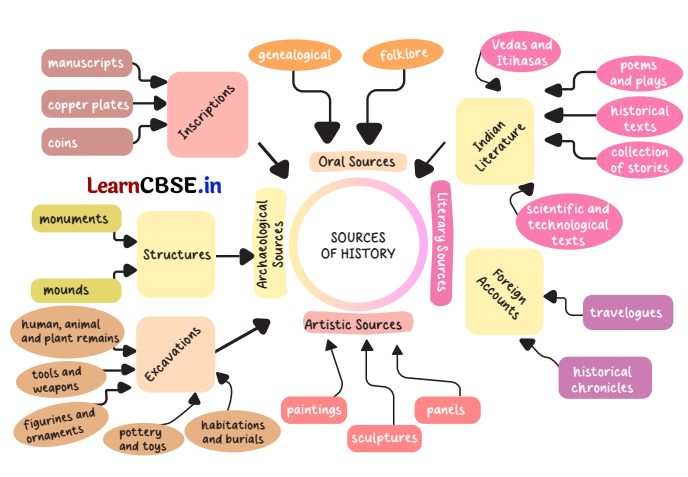
4. Write the two groups of sources in which we can study the history of ancient India.
Answer:
The history of ancient India is studied through two main groups of sources:
1. Archaeological Sources – such as inscriptions, coins, monuments, tools and pottery.
2. Literary Sources – such as the Vedas, Ramayana, Mahabharata, Arthashastra, Harshacharita and other ancient books.
5. Describe the tools and weapons of Palaeolithic Age.
Answer:
Palaeolithic people made simple and rough tools from stone, wood and bones. They used hand-axes, scrapers, choppers, knives, spears and arrows for hunting animals, cutting meat, digging roots and protecting themselves from wild animals.
6. What was the first discovery of man? Describe it in detail.
Answer:
The first great discovery of early humans was fire. They discovered fire by rubbing two stones together or through natural causes like lightning. Fire provided warmth during cold weather, protected people from wild animals, helped them cook food and gave light at night. The discovery of fire greatly improved human life and marked an important step in human progress.
Course Curriculum
No Curriculum Added Yet
Course content will be added soon.
This course is offered directly by the platform and is not tied to a specific instructor.
0
0 Reviews
No Reviews Yet
Be the first to review this course.