-
Mayur Vihar 3 Delhi, 110096 India
Free Course
Class 9 Science Unit Test 2 Questions and Answers
Class 9 Science Unit Test - 2 Questions and Answers
Course Overview
UNIT TEST – 2
Subject: Science | Class: IX
Maximum Marks: 20 | Time: 40 Minutes
### उत्तरमाला (Answer Key) – हिंदी एवं English
Class 9 Science Unit Test 2 Questions and Answers
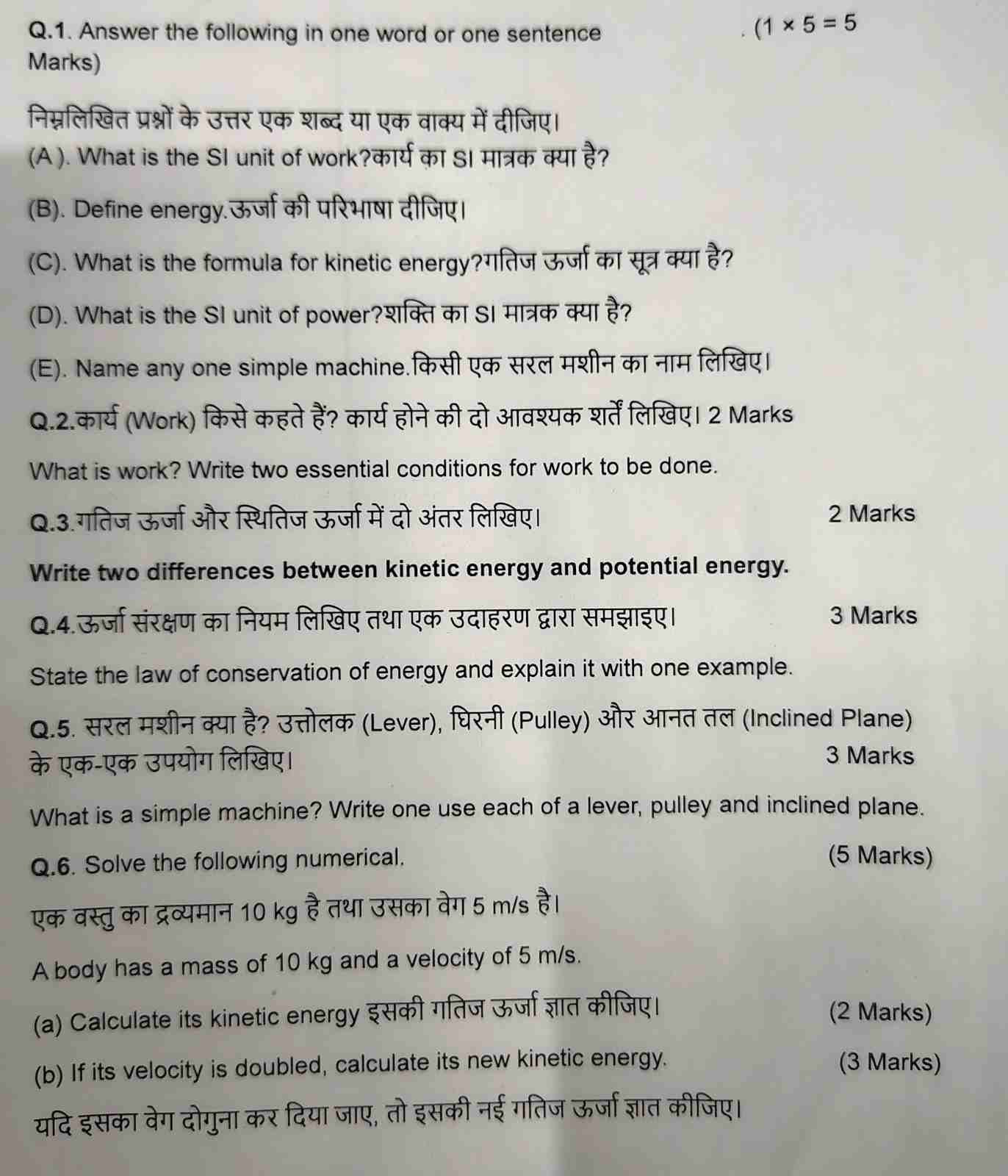
### Q.1. निम्नलिखित प्रश्नों के उत्तर एक शब्द या एक वाक्य में दीजिए।
Answer the following in one word or one sentence. (1 × 5 = 5)
(A) What is the SI unit of work? कार्य का SI मात्रक क्या है?
उत्तर (Hindi): कार्य का SI मात्रक जूल (Joule) है।
Answer (English): The SI unit of work is Joule (J).
(B) Define energy. ऊर्जा की परिभाषा दीजिए।
उत्तर (Hindi): कार्य करने की क्षमता को ऊर्जा कहते हैं।
Answer (English): Energy is defined as the capacity to do work.
(C) What is the formula for kinetic energy? गतिज ऊर्जा का सूत्र क्या है?
उत्तर (Hindi): गतिज ऊर्जा का सूत्र है:
KE=\\frac{1}{2}mv^2
Answer (English): The formula for kinetic energy is:
KE=\\frac{1}{2}mv^2
जहाँ (Where):
* m = द्रव्यमान (Mass)
* v = वेग (Velocity)
(D) What is the SI unit of power? शक्ति का SI मात्रक क्या है?
उत्तर (Hindi): शक्ति का SI मात्रक वाट (Watt) है।
Answer (English): The SI unit of power is Watt (W).
(E) Name any one simple machine. किसी एक सरल मशीन का नाम लिखिए।
उत्तर (Hindi): उत्तोलक (Lever) एक सरल मशीन है।
Answer (English): A lever is a simple machine.
### Q.2. कार्य (Work) किसे कहते हैं? कार्य होने की दो आवश्यक शर्तें लिखिए।
What is work? Write two essential conditions for work to be done. (2 Marks)
उत्तर (Hindi):
जब किसी वस्तु पर बल लगाने से उसमें बल की दिशा में विस्थापन होता है, तो भौतिकी में किए गए कार्य को कार्य कहते हैं।
कार्य होने की दो आवश्यक शर्तें:
* वस्तु पर बाहरी बल लगना चाहिए।
* वस्तु में बल की दिशा में विस्थापन होना चाहिए।
Answer (English):
Work is said to be done when a force applied on an object produces displacement in the direction of the force.
Two essential conditions for work to be done:
* A force must act on the object.
* The object must be displaced in the direction of the force.
### Q.3. गतिज ऊर्जा और स्थितिज ऊर्जा में दो अंतर लिखिए।
Write two differences between kinetic energy and potential energy. (2 Marks)
उत्तर (Hindi):
| गतिज ऊर्जा (Kinetic Energy) | स्थितिज ऊर्जा (Potential Energy) |
| ---------------------------------------------------- | ------------------------------------------------------------------------- |
| 1. गति के कारण उत्पन्न ऊर्जा को गतिज ऊर्जा कहते हैं। | 1. स्थिति या अवस्था के कारण उत्पन्न ऊर्जा को स्थितिज ऊर्जा कहते हैं। |
| 2. यह वस्तु के द्रव्यमान और वेग पर निर्भर करती है। | 2. गुरुत्वीय स्थितिज ऊर्जा वस्तु के द्रव्यमान और ऊँचाई पर निर्भर करती है। |
Answer (English):
| Kinetic Energy | Potential Energy |
| ---------------------------------------------------------------------------- | ------------------------------------------------------------------------------------------------- |
| 1. Energy possessed by an object due to its motion is called kinetic energy. | 1. Energy possessed by an object due to its position or configuration is called potential energy. |
| 2. It depends on the mass and velocity of the object. | 2. Gravitational potential energy depends on the mass and height of the object. |
### Q.4. ऊर्जा संरक्षण का नियम लिखिए तथा एक उदाहरण द्वारा समझाइए।
State the law of conservation of energy and explain it with one example. (3 Marks)
उत्तर (Hindi):
ऊर्जा संरक्षण का नियम: ऊर्जा संरक्षण के नियम के अनुसार, ऊर्जा न तो उत्पन्न की जा सकती है और न ही नष्ट की जा सकती है। ऊर्जा केवल एक रूप से दूसरे रूप में परिवर्तित हो सकती है। ब्रह्मांड की कुल ऊर्जा सदैव स्थिर रहती है।
उदाहरण – स्वतंत्र रूप से गिरती हुई वस्तु:
जब किसी वस्तु को ऊँचाई से गिराया जाता है:
* प्रारंभ में वस्तु में स्थितिज ऊर्जा अधिकतम और गतिज ऊर्जा शून्य होती है (यदि वह विराम से छोड़ी गई हो)।
* नीचे गिरते समय स्थितिज ऊर्जा घटती है और गतिज ऊर्जा बढ़ती है।
* जमीन पर पहुँचने से ठीक पहले गतिज ऊर्जा अधिकतम हो जाती है।
इस प्रकार कुल यांत्रिक ऊर्जा संरक्षित रहती है (वायु प्रतिरोध की उपेक्षा करने पर)।
Answer (English):
Law of Conservation of Energy: According to this law, energy can neither be created nor destroyed. It can only be transformed from one form to another. The total energy of the universe always remains constant.
Example – A freely falling object:
When an object falls freely from a height:
* Initially, its potential energy is maximum and kinetic energy is zero (if released from rest).
* During the fall, potential energy decreases and kinetic energy increases.
* Just before reaching the ground, kinetic energy becomes maximum.
Thus, the total mechanical energy remains conserved (neglecting air resistance).
### Q.5. सरल मशीन क्या है? उत्तोलक (Lever), घिरनी (Pulley) और आनत तल (Inclined Plane) के एक-एक उपयोग लिखिए।
What is a simple machine? Write one use each of a lever, pulley and inclined plane. (3 Marks)
उत्तर (Hindi):
सरल मशीन: सरल मशीन एक ऐसा उपकरण है जो हमारे कार्य को आसान बनाता है। यह बल की दिशा या परिमाण को बदल सकता है।
सरल मशीनों के उपयोग:
* उत्तोलक (Lever): बोतल का ढक्कन खोलने या भारी वस्तु उठाने में उपयोग होता है।
* घिरनी (Pulley): कुएँ से पानी निकालने में उपयोग होती है।
* आनत तल (Inclined Plane): भारी सामान को ट्रक में चढ़ाने के लिए ढलान का उपयोग किया जाता है।
Answer (English):
Simple Machine: A simple machine is a device that makes our work easier by changing the magnitude or direction of force.
Uses of simple machines:
* Lever: Used to open bottle caps or lift heavy objects.
* Pulley: Used to draw water from a well.
* Inclined Plane: Used to load heavy goods into a truck through a sloping ramp.


### Q.6. Solve the following numerical. (5 Marks)
प्रश्न (Question):
एक वस्तु का द्रव्यमान 10 kg है तथा उसका वेग 5 m/s है।
A body has a mass of 10 kg and a velocity of 5 m/s.
### (a) Calculate its kinetic energy. (2 Marks)
दिया गया (Given):
* द्रव्यमान (Mass), m = 10 kg
* वेग (Velocity), v = 5 m/s
सूत्र (Formula):
KE=\\frac{1}{2}mv^2
हल (Solution):
मान रखने पर (Putting the values):
KE=\\frac{1}{2}\\times10\\times5^2KE=5\\times25\\boxed{KE=125\\ J}
उत्तर (Answer): वस्तु की गतिज ऊर्जा 125 जूल है।
The kinetic energy of the body is 125 Joules.
### (b) If its velocity is doubled, calculate its new kinetic energy. (3 Marks)
दिया गया (Given):
* द्रव्यमान (Mass), m = 10 kg
* प्रारंभिक वेग (Initial velocity) = 5 m/s
* नया वेग (New velocity) = 2 × 5 = 10 m/s
सूत्र (Formula):
KE=\\frac{1}{2}mv^2
हल (Solution):
KE=\\frac{1}{2}\\times10\\times10^2KE=5\\times100\\boxed{KE=500\\ J}
उत्तर (Answer):
नई गतिज ऊर्जा = 500 जूल (500 Joules)।
महत्त्वपूर्ण निष्कर्ष (Important Conclusion):
जब किसी वस्तु का वेग दोगुना कर दिया जाता है, तो उसकी गतिज ऊर्जा चार गुना हो जाती है, क्योंकि गतिज ऊर्जा वेग के वर्ग के समानुपाती होती है।
When the velocity of an object is doubled, its kinetic energy becomes four times because kinetic energy is proportional to the square of velocity.
### Quick Revision – महत्वपूर्ण सूत्र (Important Formulas)
| भौतिक राशि (Quantity) | सूत्र (Formula) |
| -------------------------------- | --------------- |
| कार्य (Work) | |
| गतिज ऊर्जा (Kinetic Energy) | |
| स्थितिज ऊर्जा (Potential Energy) | |
| शक्ति (Power) | |
SI Units:
* Work – Joule (J)
* Energy – Joule (J)
* Power – Watt (W)
* Force – Newton (N)
* Displacement – Metre (m)
सुझाव: परीक्षा में संख्यात्मक प्रश्न हल करते समय हमेशा Given, Formula, Substitution और Final Answer लिखें। इससे पूरे अंक प्राप्त करने में मदद मिलती है।
Course Curriculum
No Curriculum Added Yet
Course content will be added soon.
This course is offered directly by the platform and is not tied to a specific instructor.
0
0 Reviews
No Reviews Yet
Be the first to review this course.