-
Mayur Vihar 3 Delhi, 110096 India
Free Course
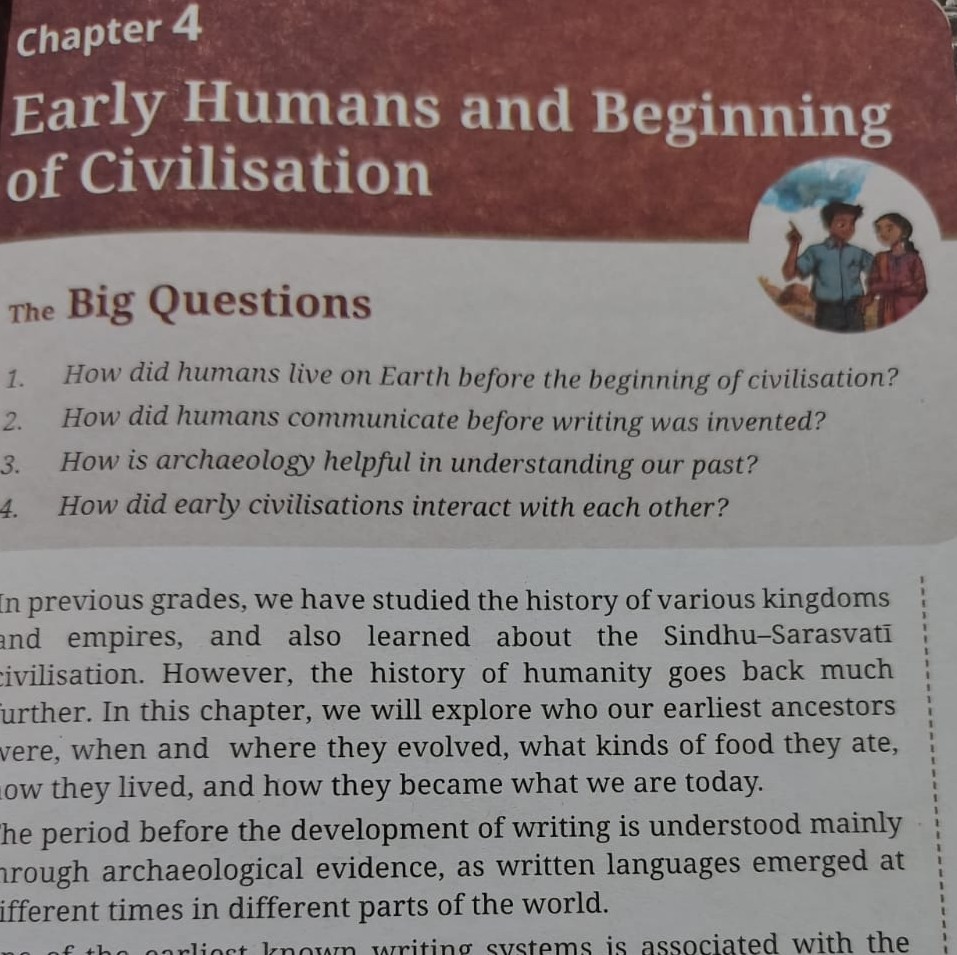
Class 9 Social Science Chapter 4 Early Humans and Beginning of civilization Excercise Questions and Answers
Class 9 Social Science Chapter 4 Early Humans and Beginning of civilization Excercise Questions and Answers
Course Overview
Class 9 Social Science Chapter 4
Early Humans and Beginning of civilization
Excercise Questions and Answers
Questions and activities
1. Do you think life became easier or more challenging after humans started farming? Give two reasons for your answer.
2. The environment offers human societies both opportunities as well as challenges. Explain with reference to early farming communities and river-valley civilisations.
3. Why do historians divide early human history into different ages such as Stone Age, Bronze Age, and Iron Age? What does this classification tell us about human progress?
4. Imagine you are a Neolithic farmer. Describe one day of your life. What challenges would you face that a hunter-gatherer would not?
5. Imagine that the Harappan script gets deciphered tomorrow, What new types of information do you think historians migh learn?
6. Prepare a table with three columns-Palaeolithic, Mesolithic, and Neolithic and fill in their distinctive features: tools, settlements art, and subsistence.
7. "Bronze Age civilisations developed independently but shared common features." Examine this statement with reference to the civilisations given in the chapter.
8. Although rivers provided many benefits, they also created challenges for early societies. Discuss both the advantages and disadvantages of settling near rivers.
9. With the help of your teacher, find out more about the Code of Hammurabi. Why was it important? Do you think it was fair to all sections of society? Give reasons for your answer.
10. If you had to choose one major innovation from early civilisations that changed the world permanently, what would it be and why?
11. Compare the social hierarchy and daily life of people in the Egyptian civilisation with those in Mesopotamia or China. What similarities and differences do you notice?
12. Activity: Using maps, locate the major rivers and civilisations of Mesopotamia, Egypt, China, and the Sindhu-Sarasvatī Valley. Mark the trade links between them.
13. Activity: Choose one early civilisation (Mesopotamia, Egypt, or China) and prepare a mini-scrapbook or a presentation showing their innovations in tools, writing, art, and architecture. Include pictures, brief descriptions, and explain their significance
Answers
1. Do you think life became easier or more challenging after humans started farming? Give two reasons for your answer.
Life became easier in some ways but more challenging in others.
Reasons:
Farming provided a regular supply of food, so people no longer had to move constantly in search of food.
However, farmers had to work hard, depend on weather, and protect crops from pests and animals, making life more demanding.
2. The environment offers human societies both opportunities as well as challenges. Explain with reference to early farming communities and river-valley civilisations.
The environment provided fertile land, water, and a suitable climate, which helped early farming communities grow crops and settle permanently near rivers. This led to the rise of great river-valley civilisations.
At the same time, these societies faced challenges such as floods, droughts, changing seasons, and crop failures. They had to develop irrigation systems and manage natural resources carefully to survive.
3. Why do historians divide early human history into different ages such as Stone Age, Bronze Age, and Iron Age? What does this classification tell us about human progress?
Historians divide early human history into different ages based on the materials used to make tools and weapons.
Stone Age: Tools made mainly of stone.
Bronze Age: Bronze tools and the growth of towns and trade.
Iron Age: Strong iron tools improved farming, warfare, and technology.
This classification shows how humans advanced in technology, skills, agriculture, trade, and civilisation over time.
4. Imagine you are a Neolithic farmer. Describe one day of your life. What challenges would you face that a hunter-gatherer would not?
I wake up early to water my crops and feed my animals. I spend the day ploughing fields, removing weeds, repairing fences, and storing grain for the future. In the evening, I check that my animals are safe before resting.
Unlike a hunter-gatherer, I must worry about crop failure, drought, floods, pests, storing food, and protecting my fields from wild animals. My family depends on a successful harvest for survival.
5. Imagine that the Harappan script gets deciphered tomorrow. What new types of information do you think historians might learn?
If the Harappan script is deciphered, historians may learn about:
The language spoken by the Harappans.
Their system of government and administration.
Religious beliefs and rituals.
Trade records and business transactions.
Names of rulers, cities, and important people.
Laws, education, and daily life.
6. Table: Palaeolithic, Mesolithic, and Neolithic Ages
Feature Palaeolithic Mesolithic Neolithic
Tools Rough stone tools Small stone tools (microliths) Polished stone tools
Settlements Nomadic life in caves and shelters Temporary camps Permanent villages
Art Cave paintings Rock paintings Pottery, weaving, and decorative art
Subsistence Hunting and gathering Hunting, fishing, and gathering Farming and animal domestication
7. "Bronze Age civilisations developed independently but shared common features." Explain.
Although Bronze Age civilisations such as Mesopotamia, Egypt, China, and the Sindhu-Sarasvatī (Harappan) civilisation developed independently, they had many similarities:
Settled near rivers.
Practised agriculture.
Used bronze tools.
Built planned cities.
Developed writing systems.
Engaged in trade.
Had organised governments and social classes.
However, each civilisation had its own language, culture, religion, and traditions.
8. Although rivers provided many benefits, they also created challenges for early societies. Discuss.
Advantages:
Fertile soil for farming.
Water for drinking and irrigation.
Easy transport and trade.
Fish and other resources.
Disadvantages:
Floods destroyed crops and homes.
Droughts reduced food production.
Spread of diseases.
River course changes affected settlements.
9. Code of Hammurabi
The Code of Hammurabi was one of the earliest written law codes in ancient Mesopotamia.
Importance:
Established clear laws.
Promoted justice and order.
Fixed punishments for crimes.
Protected property and trade.
Was it fair? It was partly fair because everyone was expected to follow the law. However, punishments often differed according to a person's social status, so it was not equally fair to all sections of society.
10. Which innovation changed the world permanently?
Writing was one of the greatest innovations.
Reasons:
Helped preserve knowledge.
Improved communication.
Made administration easier.
Encouraged education and trade.
Allowed history to be recorded for future generations.
11. Compare Egyptian civilisation with Mesopotamia.
Similarities
Both developed near rivers.
Practised agriculture.
Had kings and social classes.
Built magnificent monuments.
Developed writing systems.
Differences
Egypt Mesopotamia
Developed along the Nile River Developed between the Tigris and Euphrates Rivers
Pharaoh was considered a god Kings were powerful but not gods
Hieroglyphic writing Cuneiform writing
Built pyramids Built ziggurats
Annual Nile floods were predictable Floods were less predictable
12. Activity: Locate major rivers and civilisations
Mark these on a world map:
Civilisation River
Mesopotamia Tigris and Euphrates
Egypt Nile
China Huang He (Yellow River)
Sindhu-Sarasvatī (Harappan) Indus and Sarasvatī (Ghaggar-Hakra)
Also draw trade links connecting:
Mesopotamia ↔ Sindhu-Sarasvatī
Mesopotamia ↔ Egypt
Mesopotamia ↔ China (indirectly through trade routes)
13. Activity: Mini-Scrapbook (Example – Ancient Egypt)
Title: Ancient Egyptian Civilisation
1. Tools
Bronze tools
Farming equipment
2. Writing
Hieroglyphics written on papyrus.
3. Art
Wall paintings
Sculptures
Jewellery
4. Architecture
Pyramids
Temples
Sphinx
Significance
Advanced engineering.
Preserved history through writing.
Influenced architecture, mathematics, and art.
Contributed to the development of early civilisation.
Course Curriculum
No Curriculum Added Yet
Course content will be added soon.
This course is offered directly by the platform and is not tied to a specific instructor.
0
0 Reviews
No Reviews Yet
Be the first to review this course.