-
Mayur Vihar 3 Delhi, 110096 India
Free Course
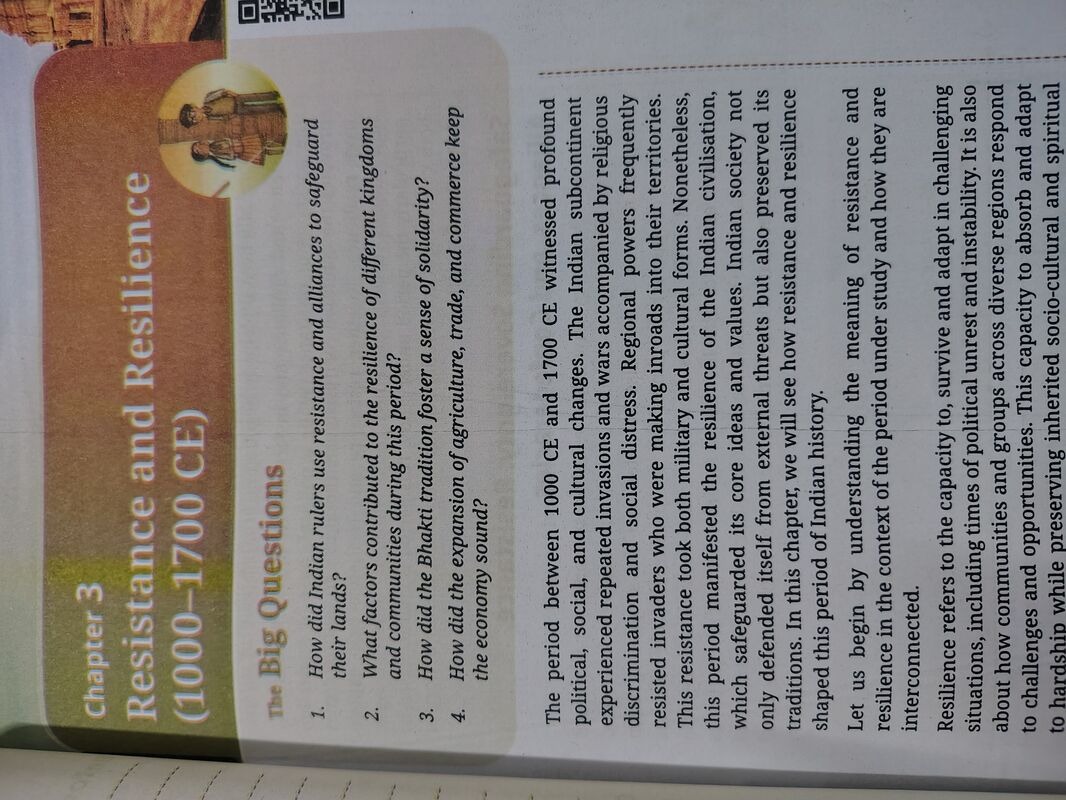
Class 9 Understanding Society Part 2 Chapter 2 Resistance and Resilience (1000-1700 CE) Excercise Questions & Answers or Solutions
Class 9 Understanding Society Part 2 Chapter 2 Resistance and Resilience (1000-1700 CE) Excercise Questions & Answers or Solutions
Course Overview
Class 9 Understanding Society Part 2 Chapter 2 Resistance and Resilience (1000-1700 CE) Excercise Questions & Answers or Solutions
### Questions and Answers
Topic: Resistance and Resilience in Indian History
### Q1. Choose the most appropriate answer.
Resistance and resilience are closely connected because:
Answer: (b) Resilience enables communities to endure difficulties and sustain resistance.
### Q2. Why and how did groups such as the Sikhs, Marathas, and Rajputs assert their political power and identity during periods of changing political authority?
Answer: The Sikhs, Marathas, and Rajputs asserted their political power to protect their independence, culture, traditions and territories. They established strong armies, built forts, formed alliances and organised local communities. They also challenged powerful rulers to establish their own kingdoms and identities.
### Q3. Why did some Rajput rulers decide to negotiate alliances with the Mughal power?
Answer: Some Rajput rulers negotiated alliances with the Mughals to maintain peace, protect their kingdoms and gain political advantages. These alliances provided them with important positions in the Mughal administration and military, while allowing them to retain control over their territories.
### Q4. Imagine a market in a port town of India such as Surat, Masulipatnam, or Puducherry. You are a foreign trader from Italy or France and want to make a deal of cotton textiles. How would you secure the product in the local market? Whose help would you seek and what kind of challenges would you face?
Answer: As a foreign trader, I would seek the help of local merchants, brokers, translators and textile producers to purchase cotton textiles. I would negotiate prices, check the quality and arrange transportation.
I might face the following challenges:
* Language barriers while communicating with local traders.
* Differences in the quality and designs of textiles.
* Fluctuations in prices and transportation costs.
* Competition from other foreign traders.
* Difficulties in understanding local customs and trade practices.
### Q5. Analyse the various functions of forts and fortresses. How did rulers perceive the importance of forts in terms of strategic concerns?
Answer: Forts and fortresses served several important functions:
* Military protection: They protected kingdoms from enemy attacks.
* Defence: They provided shelter to soldiers and weapons.
* Political power: They represented the strength and authority of rulers.
* Administrative centres: Some forts were used for governance and storing important records.
* Economic security: They protected royal treasures, food supplies and trade routes.
Rulers considered forts essential for protecting their territories, controlling strategic locations and maintaining political independence.
### Q6. What architectural changes occurred in temple construction during the period under study? How do these changes reflect upon the resilient nature of Indian civilisation?
Answer: During this period, temple architecture became more elaborate and diverse. Temples developed taller towers, larger halls, decorated pillars, gateways and fortified temple complexes. Regional architectural styles also developed.
These changes reflect the resilience of Indian civilisation because religious traditions, art, architecture and cultural practices continued to flourish despite political changes and invasions.
### Q7. A kingdom has limited military resources but possesses fertile agricultural land, strong local support, and detailed knowledge of its terrain. Explain two ways in which these resources could contribute to the kingdom's resilience when faced with a threat.
Answer:
1\. Food security: Fertile agricultural land would provide sufficient food supplies to soldiers and people during difficult times, helping the kingdom survive long conflicts.
2\. Local support and geographical knowledge: Local people could provide information, resources and assistance. Knowledge of hills, forests and rivers would help the kingdom defend itself effectively against enemies.
### Q8. Consider the following statement: "A tradition becomes more resilient when people can carry it with them." Do you agree? Explain using examples from the Bhakti tradition.
Answer: Yes, I agree with this statement. The Bhakti tradition became resilient because people could practise devotion anywhere without depending entirely on temples or rituals.
Bhakti saints such as Kabir, Mirabai and Guru Nanak spread their teachings through songs, poems, prayers and devotional gatherings. Their messages travelled from one region to another and were passed down through generations. This helped the Bhakti tradition survive and flourish.
### Q9. Voices from the Past
Choose any two of the following and write a short first-person account explaining what resilience means from that person's perspective.
(A) A Bhakti Saint
Answer: I am a Bhakti saint. For me, resilience means remaining devoted to God despite difficulties and opposition. I spread the message of love, equality and devotion through songs and poems. I believe that true devotion does not depend on wealth, caste or social status. My teachings encourage people to remain strong and united.
(B) A Rajput Soldier
Answer: I am a Rajput soldier. For me, resilience means showing courage, loyalty and determination while protecting my kingdom and people. I remain committed to my ruler and homeland even during difficult times. I believe that unity, discipline and knowledge of our land make our kingdom strong.
C) An Ahom Commander
Answer: I am an Ahom commander. For me, resilience means protecting my kingdom through courage, planning and unity. I train my soldiers and use my knowledge of rivers, forests and local terrain to defend our land. I believe that strong leadership and people's support help a kingdom survive difficult times.
(D) A Maratha Administrator
Answer: I am a Maratha administrator. For me, resilience means managing the kingdom wisely during difficult times. I ensure proper collection of revenue, storage of food and maintenance of forts. I believe that good administration, strong local support and careful planning make a kingdom powerful.
(E) A Merchant
Answer: I am a merchant. For me, resilience means continuing trade even during wars and political difficulties. I maintain good relations with local traders, protect my goods and find alternative trade routes. I believe that cooperation and determination help trade and society survive.
(F) A Jat Leader
Answer: I am a Jat leader. For me, resilience means protecting my community, land and traditions. I unite people, encourage cooperation and organise resources to face challenges. I believe that unity, courage and local support make our community strong.


Course Curriculum
No Curriculum Added Yet
Course content will be added soon.
This course is offered directly by the platform and is not tied to a specific instructor.
0
0 Reviews
No Reviews Yet
Be the first to review this course.