-
Mayur Vihar 3 Delhi, 110096 India
Free Course
Class 10 Social Science Question Paper with Solution Year 2026-2027 on School Level
Class 10 Social Science Question Paper with Solution Year 2026-2027 on School Level
Course Overview
Class 10 Social Science Question Paper with Solution Year 2026-2027 on School Level
नीचे दोनों प्रश्न Hindi + English Medium में MCQ format में दिए गए हैं, साथ में सही उत्तर और व्याख्या भी है।
CLASS 10 – SOCIAL SCIENCE
SECTION A: HISTORY | खण्ड-क: इतिहास
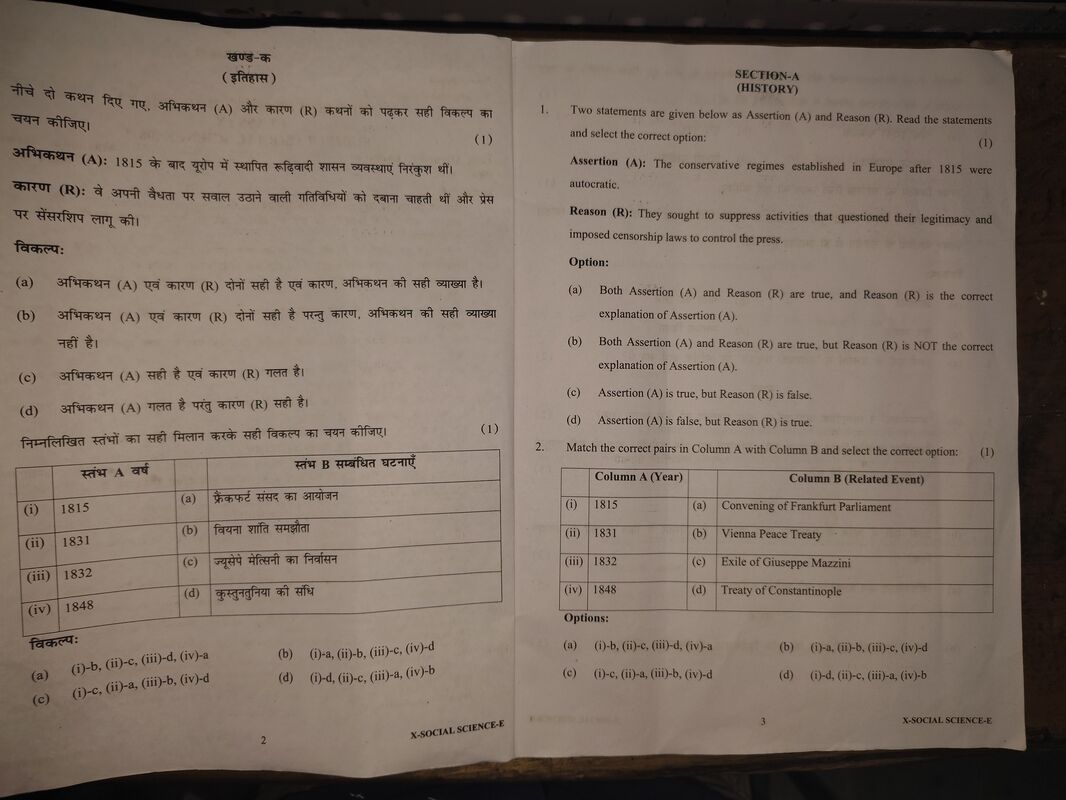
Q1. अभिकथन एवं कारण / Assertion and Reason (1 Mark)
प्रश्न (Hindi): नीचे दो कथन दिए गए हैं—अभिकथन (A) और कारण (R)। सही विकल्प का चयन कीजिए।
Question (English): Two statements are given below as Assertion (A) and Reason (R). Select the correct option.
अभिकथन (A) / Assertion (A):
1815 के बाद यूरोप में स्थापित रूढ़िवादी शासन व्यवस्थाएँ निरंकुश थीं।
The conservative regimes established in Europe after 1815 were autocratic.
कारण (R) / Reason (R):
वे अपनी वैधता पर सवाल उठाने वाली गतिविधियों को दबाना चाहती थीं और प्रेस पर सेंसरशिप लागू करती थीं।
They sought to suppress activities that questioned their legitimacy and imposed censorship on the press.
विकल्प / Options:
(a) अभिकथन (A) एवं कारण (R) दोनों सही हैं तथा कारण, अभिकथन की सही व्याख्या है।
Both Assertion (A) and Reason (R) are true, and Reason (R) is the correct explanation of Assertion (A).
(b) अभिकथन (A) एवं कारण (R) दोनों सही हैं, परंतु कारण, अभिकथन की सही व्याख्या नहीं है।
Both Assertion (A) and Reason (R) are true, but Reason (R) is not the correct explanation of Assertion (A).
(c) अभिकथन (A) सही है, परंतु कारण (R) गलत है।
Assertion (A) is true, but Reason (R) is false.
(d) अभिकथन (A) गलत है, परंतु कारण (R) सही है।
Assertion (A) is false, but Reason (R) is true.
सही उत्तर / Correct Answer: (a)
व्याख्या / Explanation:
1815 के बाद यूरोप के रूढ़िवादी शासक उदारवाद और राष्ट्रवाद के प्रसार को रोकना चाहते थे। इसलिए उन्होंने विरोधी गतिविधियों को दबाया और प्रेस पर सेंसरशिप लगाई।
After 1815, conservative rulers in Europe wanted to prevent the spread of liberalism and nationalism. Therefore, they suppressed opposition and imposed censorship on the press.
---
Q2. सही मिलान कीजिए / Match the Following (1 Mark)
प्रश्न (Hindi): स्तंभ A में दिए गए वर्षों का स्तंभ B में दी गई संबंधित घटनाओं से सही मिलान कीजिए।
Question (English): Match the years given in Column A with the corresponding events in Column B.
स्तंभ A: वर्ष / Column A: Year
(i) 1815
(ii) 1831
(iii) 1832
(iv) 1848
स्तंभ B: संबंधित घटनाएँ / Column B: Related Events
(a) फ्रैंकफर्ट संसद का आयोजन / Convening of the Frankfurt Parliament
(b) वियना कांग्रेस / Congress of Vienna
(c) ज्यूसेपे मेत्सिनी का निर्वासन / Exile of Giuseppe Mazzini
(d) कुस्तुनतुनिया की संधि / Treaty of Constantinople
विकल्प / Options:
(a) (i)–(b), (ii)–(c), (iii)–(d), (iv)–(a)
(b) (i)–(a), (ii)–(b), (iii)–(c), (iv)–(d)
(c) (i)–(c), (ii)–(a), (iii)–(b), (iv)–(d)
(d) (i)–(d), (ii)–(c), (iii)–(a), (iv)–(b)
सही उत्तर / Correct Answer: (a)
व्याख्या / Explanation:
- 1815: वियना कांग्रेस / Congress of Vienna
- 1831: ज्यूसेपे मेत्सिनी ने यंग इटली की स्थापना की; इसी वर्ष उन्हें निर्वासन का सामना करना पड़ा। / Giuseppe Mazzini founded Young Italy and faced exile.
- 1832: कुस्तुनतुनिया की संधि / Treaty of Constantinople
- 1848: फ्रैंकफर्ट संसद का आयोजन / Frankfurt Parliament convened.
नोट / Note: प्रश्न में दी गई घटनाओं और वर्षों का मिलान पाठ्यपुस्तक के संदर्भ में किया गया है।Answer Key / उत्तरमाला:
Q1 — (a)
Q2 — (a)
CLASS 10 – SOCIAL SCIENCE
SECTION A: HISTORY | खण्ड-क: इतिहास
MCQs, Short Answer & Long Answer Questions
Hindi & English Medium | उत्तर सहित
Q3. बहुविकल्पीय प्रश्न / Multiple Choice Question (1 Mark)
प्रश्न (Hindi): सितंबर 1932 में महात्मा गांधी और डॉ. बी.आर. अंबेडकर के बीच हुए किस समझौते के तहत प्रांतीय और केंद्रीय विधायी परिषदों में सीटें आरक्षित की गईं?
Question (English): Under which pact signed in September 1932 between Mahatma Gandhi and Dr. B. R. Ambedkar were seats reserved in provincial and central legislative councils?
विकल्प / Options:
(a) गांधी-इरविन समझौता / Gandhi-Irwin Pact
(b) पूना पैक्ट / Poona Pact
(c) लखनऊ समझौता / Lucknow Pact
(d) दिल्ली प्रस्ताव / Delhi Proposal
सही उत्तर / Correct Answer: (b) पूना पैक्ट / Poona Pact
व्याख्या / Explanation: पूना पैक्ट पर 24 सितंबर 1932 को हस्ताक्षर किए गए थे। इसके तहत दलित वर्गों के लिए प्रांतीय विधानसभाओं में आरक्षित सीटों की व्यवस्था की गई।
The Poona Pact was signed on 24 September 1932. It provided for reserved seats for the Depressed Classes in provincial legislatures.
Q4. रिक्त स्थान की पूर्ति / Fill in the Blank (1 Mark)
प्रश्न (Hindi): महात्मा गांधी ने अपनी प्रसिद्ध पुस्तक __________ (1909) में घोषणा की थी कि भारत में ब्रिटिश शासन भारतीयों के सहयोग से ही स्थापित हुआ था।
Question (English): Mahatma Gandhi declared in his famous book __________ (1909) that British rule in India was established with the cooperation of Indians.
विकल्प / Options:
(a) आनंदमठ / Anandamath
(b) भारत की खोज / The Discovery of India
(c) हिंद स्वराज / Hind Swaraj
(d) स्वराज्य विचार / Swaraj Vichar
सही उत्तर / Correct Answer: (c) हिंद स्वराज / Hind Swaraj
व्याख्या / Explanation: महात्मा गांधी ने 1909 में हिंद स्वराज पुस्तक लिखी थी। इसमें उन्होंने ब्रिटिश शासन की आलोचना की और बताया कि भारतीयों के सहयोग ने भारत में ब्रिटिश सत्ता को बनाए रखने में महत्त्वपूर्ण भूमिका निभाई।
Mahatma Gandhi wrote Hind Swaraj in 1909. He criticised British rule and explained the role of Indian cooperation in sustaining British power in India.
Q5 (a). लघु उत्तरीय प्रश्न / Short Answer Question (2 Marks)
प्रश्न (Hindi): 19वीं सदी के उत्तरार्ध में 'उदारवादी राष्ट्रवाद' के आर्थिक अर्थ क्या थे?
Question (English): What was the economic meaning of 'Liberal Nationalism' in the second half of the 19th century?
उत्तर (Hindi):
19वीं सदी के उत्तरार्ध में उदारवादी राष्ट्रवाद के आर्थिक अर्थ निम्नलिखित थे:
- आर्थिक स्वतंत्रता: व्यापार पर लगाए गए प्रतिबंधों को समाप्त करना और वस्तुओं तथा पूँजी की स्वतंत्र आवाजाही को बढ़ावा देना।
- सीमा शुल्क में कमी: विभिन्न राज्यों के बीच सीमा शुल्क बाधाओं को हटाकर एकीकृत आर्थिक बाजार स्थापित करना।
Answer (English):
The economic meaning of Liberal Nationalism in the second half of the 19th century was:
- Economic freedom: Removing restrictions on trade and promoting the free movement of goods and capital.
- Reduction of customs barriers: Removing customs barriers between states to establish a unified economic market.
Q5 (b). अथवा / OR (2 Marks)
प्रश्न (Hindi): 'रूमानीवाद' ने सांस्कृतिक आंदोलनों के जरिए राष्ट्रवाद को कैसे बढ़ावा दिया?
Question (English): How did Romanticism promote nationalism through cultural movements?
उत्तर (Hindi):
- रूमानीवाद ने भावनाओं, लोकगीतों, लोककथाओं और लोकनृत्यों के माध्यम से राष्ट्रीय भावना को प्रोत्साहित किया।
- कलाकारों और कवियों ने साझा सांस्कृतिक विरासत को उजागर करके लोगों में राष्ट्रीय एकता की भावना विकसित की।
Answer (English):
- Romanticism encouraged national feelings through emotions, folk songs, folk tales and folk dances.
- Artists and poets highlighted a shared cultural heritage and helped develop a sense of national unity.
Q6 (a). लघु उत्तरीय प्रश्न / Short Answer Question (3 Marks)
प्रश्न (Hindi): विक्टोरियाकालीन ब्रिटेन में उच्च वर्ग (अभिजात वर्ग और पूँजीपति) हाथ से बनी वस्तुओं को प्राथमिकता क्यों देते थे?
Question (English): Why did the upper classes (aristocrats and capitalists) in Victorian Britain prefer handmade goods?
उत्तर (Hindi):
विक्टोरियाकालीन ब्रिटेन में उच्च वर्ग हाथ से बनी वस्तुओं को निम्नलिखित कारणों से प्राथमिकता देता था:
- विशिष्टता: हाथ से बनी वस्तुएँ विशेष और दुर्लभ मानी जाती थीं।
- उच्च गुणवत्ता: इन वस्तुओं में बारीक कारीगरी और उत्कृष्ट गुणवत्ता होती थी।
- प्रतिष्ठा का प्रतीक: हाथ से बनी महँगी वस्तुओं का उपयोग सामाजिक प्रतिष्ठा और संपन्नता का प्रतीक माना जाता था।
Answer (English):
The upper classes in Victorian Britain preferred handmade goods for the following reasons:
- Uniqueness: Handmade goods were considered special and rare.
- High quality: They often displayed fine craftsmanship and superior quality.
- Status symbol: Expensive handmade goods were considered symbols of wealth and social prestige.
Q6 (b). अथवा / OR (3 Marks)
प्रश्न (Hindi): 20वीं सदी में भारत में हथकरघा वस्त्र उत्पादन के विस्तार में किन कारकों ने योगदान दिया?
Question (English): Which factors contributed to the expansion of handloom cloth production in India in the 20th century?
उत्तर (Hindi):
- स्वदेशी आंदोलन: स्वदेशी आंदोलन ने भारतीय वस्त्रों और खादी के उपयोग को प्रोत्साहित किया।
- मशीन निर्मित कपड़े की माँग में बदलाव: कुछ क्षेत्रों में मिल के कपड़े की माँग घटने से हथकरघा उत्पादकों को अवसर मिले।
- नए डिजाइन और तकनीक: बुनकरों ने बाजार की माँग के अनुसार नए डिजाइन, बुनाई के तरीके और बेहतर तकनीकों को अपनाया।
Answer (English):
The following factors contributed to the expansion of handloom cloth production in India in the 20th century:
- Swadeshi Movement: It encouraged the use of Indian-made textiles and khadi.
- Changes in demand for mill-made cloth: In some regions, changes in demand created opportunities for handloom producers.
- New designs and techniques: Weavers adopted new designs, weaving methods and improved techniques to meet market demand.
Q7 (a). दीर्घ उत्तरीय प्रश्न / Long Answer Question (5 Marks)
प्रश्न (Hindi): जलियाँवाला बाग हत्याकांड की समीक्षा कीजिए।
Question (English): Review the Jallianwala Bagh massacre.
उत्तर (Hindi):
जलियाँवाला बाग हत्याकांड भारतीय स्वतंत्रता आंदोलन की एक महत्त्वपूर्ण घटना थी।
1. घटना की पृष्ठभूमि:
1919 में ब्रिटिश सरकार ने रॉलेट एक्ट लागू किया, जिसके तहत बिना मुकदमा चलाए लोगों को गिरफ्तार करने की अनुमति दी गई। इसके विरोध में देशभर में प्रदर्शन हुए।
2. घटना का दिन:
13 अप्रैल 1919 को बैसाखी के अवसर पर अमृतसर के जलियाँवाला बाग में एक बड़ी भीड़ एकत्र हुई थी। इसमें अनेक लोग रॉलेट एक्ट का विरोध करने के लिए आए थे।
3. जनरल डायर की कार्रवाई:
ब्रिगेडियर जनरल रेजिनाल्ड डायर ने सैनिकों को निहत्थी भीड़ पर गोली चलाने का आदेश दिया। इस घटना में सैकड़ों लोग मारे गए और अनेक घायल हुए।
4. जनता की प्रतिक्रिया:
इस हत्याकांड से पूरे देश में आक्रोश फैल गया। रवींद्रनाथ टैगोर ने विरोधस्वरूप अपनी नाइटहुड की उपाधि त्याग दी।
5. राष्ट्रीय आंदोलन पर प्रभाव:
इस घटना ने ब्रिटिश शासन के प्रति भारतीयों का विश्वास कमजोर कर दिया और स्वतंत्रता आंदोलन को अधिक व्यापक बनाने में महत्त्वपूर्ण भूमिका निभाई।
Answer (English):
The Jallianwala Bagh massacre was a major event in the Indian freedom struggle.
1. Background:
In 1919, the British government introduced the Rowlatt Act, which allowed the detention of people without trial. This led to widespread protests.
2. Date and place:
On 13 April 1919, a large crowd gathered at Jallianwala Bagh in Amritsar on the occasion of Baisakhi. Many people had assembled to protest against the Rowlatt Act.
3. Action by General Dyer:
Brigadier General Reginald Dyer ordered his troops to fire on the unarmed crowd. Hundreds of people were killed, and many others were injured.
4. Public reaction:
The massacre caused widespread anger throughout India. Rabindranath Tagore renounced his knighthood in protest.
5. Impact on the national movement:
The incident weakened Indians' faith in British rule and played an important role in strengthening the freedom movement.
Q7 (b). अथवा / OR (5 Marks)
प्रश्न (Hindi): महात्मा गांधी की दांडी यात्रा की मुख्य विशेषताओं का विश्लेषण कीजिए।
Question (English): Analyse the main features of Mahatma Gandhi's Dandi March.
उत्तर (Hindi):
महात्मा गांधी की दांडी यात्रा सविनय अवज्ञा आंदोलन की शुरुआत का एक महत्त्वपूर्ण कदम थी।
1. शुरुआत:
12 मार्च 1930 को महात्मा गांधी ने साबरमती आश्रम से दांडी तक यात्रा शुरू की।
2. यात्रा का उद्देश्य:
इसका मुख्य उद्देश्य ब्रिटिश सरकार के नमक कानून का विरोध करना था। नमक एक आवश्यक वस्तु थी, लेकिन ब्रिटिश सरकार ने इसके उत्पादन और बिक्री पर नियंत्रण लगा रखा था।
3. यात्रा की दूरी:
गांधीजी ने अपने 78 स्वयंसेवकों के साथ लगभग 240 मील (385 किलोमीटर) की यात्रा की।
4. नमक कानून का उल्लंघन:
6 अप्रैल 1930 को दांडी पहुँचकर गांधीजी ने समुद्र के पानी से नमक बनाकर ब्रिटिश नमक कानून तोड़ा।
5. आंदोलन का प्रभाव:
इस यात्रा ने देशभर में सविनय अवज्ञा आंदोलन को प्रेरित किया। अनेक लोगों ने नमक कानून तोड़ा, विदेशी वस्तुओं का बहिष्कार किया और ब्रिटिश शासन के विरुद्ध शांतिपूर्ण विरोध किया।
Answer (English):
Mahatma Gandhi's Dandi March was an important step in launching the Civil Disobedience Movement.
1. Beginning:
On 12 March 1930, Mahatma Gandhi began his march from Sabarmati Ashram to Dandi.
2. Objective:
The main objective was to oppose the British salt law. Salt was an essential commodity, but the British government controlled its production and sale.
3. Distance:
Gandhi travelled approximately 240 miles (385 kilometres) with 78 volunteers.
4. Violation of the salt law:
On 6 April 1930, Gandhi reached Dandi and made salt from seawater, breaking the British salt law.
5. Impact of the movement:
The march inspired the Civil Disobedience Movement across India. Many people broke the salt law, boycotted foreign goods and participated in peaceful protests against British rule.
Quick Answer Key / त्वरित उत्तरमाला
| प्रश्न / Question | सही उत्तर / Answer |
|---|---|
| Q3 | (b) Poona Pact / पूना पैक्ट |
| Q4 | (c) Hind Swaraj / हिंद स्वराज |
| Q5 (a) | आर्थिक स्वतंत्रता और सीमा शुल्क बाधाओं को हटाना / Economic freedom and removal of customs barriers |
| Q5 (b) | लोकगीतों, लोककथाओं और साझा संस्कृति से राष्ट्रवाद को बढ़ावा / Promoting nationalism through folk culture |
| Q6 (a) | विशिष्टता, गुणवत्ता और सामाजिक प्रतिष्ठा / Uniqueness, quality and social prestige |
| Q6 (b) | स्वदेशी आंदोलन, माँग में बदलाव और नई तकनीकें / Swadeshi Movement, changes in demand and new techniques |
| Q7 (a) | जलियाँवाला बाग हत्याकांड / Jallianwala Bagh massacre |
| Q7 (b) | दांडी यात्रा और सविनय अवज्ञा आंदोलन / Dandi March and Civil Disobedience Movement |
CLASS 10 – SOCIAL SCIENCE
SECTION A: HISTORY | खण्ड-क: इतिहास
Hindi & English Medium | Answers with Explanation
Q8. स्रोत आधारित प्रश्न / Source-Based Questions (4 Marks)
प्रश्न / Question:
दिए गए अनुच्छेद को पढ़कर निम्नलिखित प्रश्नों के उत्तर दीजिए।
Read the given passage and answer the following questions.
Q8.1 राष्ट्र-राज्य का अर्थ स्पष्ट कीजिए। (1 अंक)
Hindi Answer: राष्ट्र-राज्य वह राज्य है जिसमें अधिकांश नागरिकों और शासकों में साझा पहचान, समान इतिहास तथा सांस्कृतिक विरासत की भावना होती है।
English Answer: A nation-state is a state in which most citizens and rulers share a common identity, history and cultural heritage.
Q8.2 उन्नीसवीं सदी में यूरोप में बने किसी एक राष्ट्र-राज्य का नाम लिखिए। (1 अंक)
Hindi Answer: इटली।
English Answer: Italy.
अन्य उदाहरण / Another example: जर्मनी / Germany.
Q8.3 राष्ट्र-राज्य के निर्माण की भावना किस प्रकार निर्मित हुई? (2 अंक)
Hindi Answer: राष्ट्र-राज्य के निर्माण की भावना निम्नलिखित तरीकों से विकसित हुई:
- राष्ट्रवादी संघर्षों और आंदोलनों के माध्यम से।
- नेताओं तथा आम लोगों की सक्रिय भागीदारी और साझा इतिहास एवं विरासत की भावना से।
English Answer: The feeling of creating a nation-state emerged through:
- Nationalist struggles and movements.
- The active participation of leaders and common people, along with a sense of shared history and heritage.
Q9. मानचित्र आधारित प्रश्न / Map-Based Question (2 Marks)
प्रश्न / Question:
भारत के राजनीतिक रेखा मानचित्र पर दिए गए स्थानों की पहचान कीजिए।
Identify the following places on the political outline map of India.
Q9.1 सितंबर 1920 में भारतीय राष्ट्रीय कांग्रेस का अधिवेशन कहाँ हुआ था? (1 अंक)
उत्तर / Answer: कलकत्ता (वर्तमान कोलकाता) / Calcutta (present-day Kolkata), West Bengal.
व्याख्या / Explanation: सितंबर 1920 में भारतीय राष्ट्रीय कांग्रेस का विशेष अधिवेशन कलकत्ता में हुआ था। इसमें असहयोग आंदोलन के प्रस्ताव को स्वीकार किया गया।
The special session of the Indian National Congress was held in Calcutta in September 1920, where the proposal for the Non-Cooperation Movement was accepted.
Q9.2 गांधीजी ने नील की खेती करने वाले किसानों के समर्थन में आंदोलन कहाँ किया था? (1 अंक)
उत्तर / Answer: चंपारण / Champaran, Bihar.
व्याख्या / Explanation: 1917 में महात्मा गांधी ने बिहार के चंपारण में नील की खेती करने वाले किसानों के समर्थन में आंदोलन किया। यह भारत में गांधीजी के शुरुआती प्रमुख सत्याग्रहों में से एक था।
In 1917, Mahatma Gandhi launched a movement in Champaran, Bihar, in support of indigo cultivators. It was one of his early major satyagrahas in India.
दृष्टिबाधित परीक्षार्थियों के लिए / For Visually Impaired Candidates
| प्रश्न / Question | उत्तर / Answer |
|---|---|
| Q9.1 सितंबर 1920 में कांग्रेस अधिवेशन कहाँ हुआ? / Where was the Congress session held in September 1920? | कलकत्ता / Calcutta (Kolkata) |
| Q9.2 नील किसानों के समर्थन में गांधीजी ने आंदोलन कहाँ किया? / Where did Gandhi lead a movement in support of indigo cultivators? | चंपारण / Champaran, Bihar |
अंतिम उत्तरमाला / Final Answer Key
- Q8.1: साझा पहचान और इतिहास वाला राज्य / A state with a common identity and history.
- Q8.2: इटली / Italy.
- Q8.3: राष्ट्रवादी संघर्षों तथा नेताओं और आम लोगों की भागीदारी से / Through nationalist struggles and the participation of leaders and common people.
- Q9.1: कलकत्ता / Calcutta (Kolkata).
- Q9.2: चंपारण / Champaran.
CLASS 10 – SOCIAL SCIENCE
SECTION B: GEOGRAPHY | खण्ड-ख: भूगोल
MCQs | Hindi & English Medium | Answers with Explanation
---
Q10. रिक्त स्थान की पूर्ति / Fill in the Blank (1 Mark)
प्रश्न (Hindi): ब्राजील के रियो डी जेनेरो में 1992 में आयोजित प्रथम अंतर्राष्ट्रीय पृथ्वी सम्मेलन में 21वीं सदी में सतत विकास हासिल करने के लिए __________ को अपनाया गया था।
Question (English): At the first International Earth Summit held in Rio de Janeiro, Brazil, in 1992, __________ was adopted to achieve sustainable development in the 21st century.
विकल्प / Options:
(a) एजेंडा 21 / Agenda 21
(b) ब्रंटलैंड रिपोर्ट / Brundtland Report
(c) क्लब ऑफ रोम की घोषणा / Declaration of the Club of Rome
(d) अर्थ चार्टर 2000 / Earth Charter 2000
✅ सही उत्तर / Correct Answer: (a) एजेंडा 21 / Agenda 21
व्याख्या / Explanation:
हिंदी: एजेंडा 21 एक कार्ययोजना है, जिसे 1992 में रियो डी जेनेरो में आयोजित पृथ्वी सम्मेलन में सतत विकास को बढ़ावा देने के लिए अपनाया गया था।
English: Agenda 21 is an action plan adopted at the 1992 Earth Summit in Rio de Janeiro to promote sustainable development.
---
Q11. बहुविकल्पीय प्रश्न / Multiple Choice Question (1 Mark)
प्रश्न (Hindi): मानव पर्यावरण में मौजूद वस्तुओं को संसाधनों में परिवर्तित करने के लिए निम्नलिखित में से किनके साथ अंतःक्रिया करता है?
Question (English): Human beings interact with which of the following to transform materials available in our environment into resources?
विकल्प / Options:
(a) केवल प्रौद्योगिकी / Technology only
(b) प्रौद्योगिकी और संस्थाएँ / Technology and Institutions
(c) केवल प्रकृति और बाजार / Nature and Market only
(d) केवल रीति-रिवाज और परंपराएँ / Only Customs and Traditions
✅ सही उत्तर / Correct Answer: (b) प्रौद्योगिकी और संस्थाएँ / Technology and Institutions
व्याख्या / Explanation:
हिंदी: मनुष्य प्रकृति से उपलब्ध वस्तुओं को संसाधनों में बदलने के लिए प्रौद्योगिकी का उपयोग करता है। इस प्रक्रिया में सामाजिक, आर्थिक और राजनीतिक संस्थाएँ भी महत्त्वपूर्ण भूमिका निभाती हैं।
English: Human beings use technology to transform materials obtained from nature into resources. Social, economic and political institutions also play an important role in this process.
---
Q12. अभिकथन एवं कारण / Assertion and Reason (1 Mark)
प्रश्न (Hindi): नीचे दिए गए अभिकथन (A) और कारण (R) को पढ़कर सही विकल्प चुनिए।
Question (English): Read the following Assertion (A) and Reason (R) and select the correct option.
अभिकथन (A) / Assertion (A):
पंजाब, हरियाणा और पश्चिमी उत्तर प्रदेश में भूमि निम्नीकरण का मुख्य कारण अत्यधिक सिंचाई है।
Over-irrigation is responsible for land degradation in Punjab, Haryana and western Uttar Pradesh.
कारण (R) / Reason (R):
अत्यधिक सिंचाई से जलाक्रांतता पैदा होती है, जिससे मृदा में लवणीयता और क्षारीयता घट जाती है।
Over-irrigation leads to waterlogging, which decreases salinity and alkalinity in the soil.
विकल्प / Options:
(a) अभिकथन (A) एवं कारण (R) दोनों सही हैं तथा कारण, अभिकथन की सही व्याख्या है।
Both Assertion (A) and Reason (R) are true, and Reason (R) is the correct explanation of Assertion (A).
(b) अभिकथन (A) एवं कारण (R) दोनों सही हैं, परंतु कारण, अभिकथन की सही व्याख्या नहीं है।
Both Assertion (A) and Reason (R) are true, but Reason (R) is not the correct explanation of Assertion (A).
(c) अभिकथन (A) सही है, परंतु कारण (R) गलत है।
Assertion (A) is true, but Reason (R) is false.
(d) अभिकथन (A) गलत है, परंतु कारण (R) सही है।
Assertion (A) is false, but Reason (R) is true.
✅ सही उत्तर / Correct Answer: (c)
व्याख्या / Explanation:
हिंदी:
अभिकथन (A) सही है, क्योंकि पंजाब, हरियाणा और पश्चिमी उत्तर प्रदेश में अत्यधिक सिंचाई भूमि निम्नीकरण का एक प्रमुख कारण है।
कारण (R) गलत है, क्योंकि जलाक्रांतता से मृदा में लवणीयता और क्षारीयता बढ़ सकती है, घटती नहीं है।
English:
Assertion (A) is true because over-irrigation is a major cause of land degradation in Punjab, Haryana and western Uttar Pradesh.
Reason (R) is false because waterlogging can increase soil salinity and alkalinity rather than decrease them.
---
उत्तरमाला / Answer Key
प्रश्न / Question सही उत्तर / Correct Answer
Q10 (a) Agenda 21 / एजेंडा 21
Q11 (b) Technology and Institutions / प्रौद्योगिकी और संस्थाएँ
Q12 (c) Assertion is true, Reason is false / अभिकथन सही, कारण गलत
CLASS 10 – SOCIAL SCIENCE
SECTION B: GEOGRAPHY | खण्ड-ख: भूगोल
MCQs | Hindi & English Medium | Answers with Explanation
---
Q13. कथन आधारित प्रश्न / Statement-Based Question (1 Mark)
प्रश्न (Hindi): नीचे दो कथन, कथन I और कथन II के रूप में दिए गए हैं। दोनों कथनों को पढ़िए और सही विकल्प का चयन कीजिए।
Question (English): Two statements are given as Statement I and Statement II. Read both statements and choose the correct option.
कथन I / Statement I: तमिलनाडु भारत का पहला राज्य है जिसने सभी घरों के लिए छत पर वर्षा जल संचयन अनिवार्य कर दिया है।
Tamil Nadu was the first state in India to make rooftop rainwater harvesting compulsory for all houses across the state.
कथन II / Statement II: राजस्थान के पश्चिमी क्षेत्रों में इंदिरा गांधी नहर के आने के बाद छत पर वर्षा जल संचयन की प्रथा में अत्यधिक वृद्धि हुई है।
In the western regions of Rajasthan, rooftop rainwater harvesting has increased significantly after the arrival of the Indira Gandhi Canal.
विकल्प / Options
(a) कथन I और कथन II दोनों सही हैं।
Both Statement I and Statement II are correct.
(b) कथन I सही है और कथन II गलत है।
Statement I is correct and Statement II is incorrect.
(c) कथन I गलत है और कथन II सही है।
Statement I is incorrect and Statement II is correct.
(d) कथन I और कथन II दोनों गलत हैं।
Both Statement I and Statement II are incorrect.
✅ सही उत्तर / Correct Answer: (b)
व्याख्या / Explanation:
हिंदी: तमिलनाडु ने वर्ष 2001 में सभी घरों में छत पर वर्षा जल संचयन संरचनाएँ अनिवार्य की थीं। राजस्थान के पश्चिमी क्षेत्रों में इंदिरा गांधी नहर से जल की उपलब्धता बढ़ने के कारण पारंपरिक वर्षा जल संचयन प्रणालियों का उपयोग कम हुआ।
English: Tamil Nadu made rooftop rainwater harvesting structures compulsory for houses in 2001. In western Rajasthan, the availability of water through the Indira Gandhi Canal reduced the use of traditional rainwater harvesting systems in some areas.
---
Q14. बहुविकल्पीय प्रश्न / Multiple Choice Question (1 Mark)
प्रश्न (Hindi): भारत में संयुक्त वन प्रबंधन (JFM) कार्यक्रम सबसे पहले किस राज्य में शुरू हुआ?
Question (English): In which Indian state was the Joint Forest Management (JFM) programme first initiated?
विकल्प / Options
(a) हरियाणा / Haryana
(b) पंजाब / Punjab
(c) ओडिशा / Odisha
(d) गुजरात / Gujarat
✅ सही उत्तर / Correct Answer: (c) ओडिशा / Odisha
व्याख्या / Explanation:
हिंदी: भारत में संयुक्त वन प्रबंधन की औपचारिक शुरुआत 1988 में ओडिशा में हुई। इस कार्यक्रम में स्थानीय समुदायों को वनों के संरक्षण और प्रबंधन में शामिल किया गया।
English: The Joint Forest Management programme was formally initiated in Odisha in 1988. It involved local communities in forest protection and management.
---
Q15. बहुविकल्पीय प्रश्न / Multiple Choice Question (1 Mark)
प्रश्न (Hindi): निम्नलिखित में से किस राज्य में वर्षा जल संग्रहण के लिए 'टाँका' का प्रचुरता से उपयोग किया जाता है?
Question (English): In which of the following states is the 'Tanka' system extensively used for rainwater harvesting?
विकल्प / Options
(a) झारखंड / Jharkhand
(b) बिहार / Bihar
(c) कर्नाटक / Karnataka
(d) राजस्थान / Rajasthan
✅ सही उत्तर / Correct Answer: (d) राजस्थान / Rajasthan
व्याख्या / Explanation:
हिंदी: टाँका राजस्थान में वर्षा जल संग्रहण की एक पारंपरिक भूमिगत व्यवस्था है। इसमें छतों या खुले स्थानों से वर्षा का पानी एकत्र करके भविष्य में उपयोग के लिए सुरक्षित रखा जाता है।
English: A Tanka is a traditional underground rainwater storage system used in Rajasthan. Rainwater collected from rooftops or open areas is stored for future use.
---
Q16. सही मिलान कीजिए / Match the Following (1 Mark)
प्रश्न (Hindi): सूची-I (बाघ रिजर्व/राष्ट्रीय उद्यान) का सूची-II (संबंधित राज्य) के साथ सही मिलान कीजिए।
Question (English): Match List I (Tiger Reserves/National Parks) with List II (their respective states).
सूची-I: बाघ रिजर्व/राष्ट्रीय उद्यान
List I: Tiger Reserves/National Parks
क्रम राष्ट्रीय उद्यान / बाघ रिजर्व
a कॉर्बेट राष्ट्रीय उद्यान / Corbett National Park
b सुंदरबन राष्ट्रीय उद्यान / Sunderbans National Park
c बांधवगढ़ राष्ट्रीय उद्यान / Bandhavgarh National Park
d पेरियार बाघ रिजर्व / Periyar Tiger Reserve
सूची-II: संबंधित राज्य
List II: Respective States
संख्या राज्य / State
1 मध्य प्रदेश / Madhya Pradesh
2 केरल / Kerala
3 उत्तराखंड / Uttarakhand
4 पश्चिम बंगाल / West Bengal
विकल्प / Options
(a) a–3, b–4, c–1, d–2
(b) a–1, b–2, c–3, d–4
(c) a–4, b–3, c–2, d–1
(d) a–3, b–1, c–4, d–2
✅ सही उत्तर / Correct Answer: (a) a–3, b–4, c–1, d–2
व्याख्या / Explanation:
राष्ट्रीय उद्यान / बाघ रिजर्व संबंधित राज्य / Respective State
कॉर्बेट राष्ट्रीय उद्यान / Corbett National Park उत्तराखंड / Uttarakhand
सुंदरबन राष्ट्रीय उद्यान / Sunderbans National Park पश्चिम बंगाल / West Bengal
बांधवगढ़ राष्ट्रीय उद्यान / Bandhavgarh National Park मध्य प्रदेश / Madhya Pradesh
पेरियार बाघ रिजर्व / Periyar Tiger Reserve केरल / Kerala
---
उत्तरमाला / Answer Key
प्रश्न / Question सही उत्तर / Correct Answer
Q13 (b)
Q14 (c) Odisha / ओडिशा
Q15 (d) Rajasthan / राजस्थान
Q16 (a) a–3, b–4, c–1, d–2
CLASS 10 – SOCIAL SCIENCE
SECTION B: GEOGRAPHY | खण्ड-ख: भूगोल
Hindi & English Medium | Answers with Explanation
Q17. जैव विविधता का महत्व / Importance of Biodiversity (2 Marks)
प्रश्न (Hindi): मानव जीवन और पारिस्थितिक तंत्र के लिए जैव विविधता के महत्व को स्पष्ट कीजिए।
Question (English): Explain the importance of biodiversity for human life and the ecosystem.
उत्तर (Hindi)
जैव विविधता का मानव जीवन और पारिस्थितिक तंत्र के लिए निम्नलिखित महत्व है:
- मानव जीवन के लिए: जैव विविधता से हमें भोजन, औषधियाँ, ईंधन और अन्य आवश्यक संसाधन प्राप्त होते हैं।
- पारिस्थितिक संतुलन: यह खाद्य श्रृंखला, पोषक चक्र और पारिस्थितिक संतुलन बनाए रखने में सहायता करती है।
Answer (English)
Biodiversity is important for human life and the ecosystem in the following ways:
- For human life: It provides food, medicines, fuel and other essential resources.
- Ecological balance: It helps maintain food chains, nutrient cycles and ecological balance.
Q18. वन एवं वन्यजीव संरक्षण में स्थानीय समुदायों की भूमिका (3 Marks)
प्रश्न (Hindi): वन और वन्यजीवों की सुरक्षा में स्थानीय समुदायों के संघर्ष और भागीदारी के उदाहरण दीजिए।
Question (English): Give examples of the struggles and participation of local communities in the protection of forests and wildlife.
उत्तर (Hindi)
वन एवं वन्यजीव संरक्षण में स्थानीय समुदायों की भूमिका के प्रमुख उदाहरण निम्नलिखित हैं:
- चिपको आंदोलन: उत्तराखंड में ग्रामीणों, विशेषकर महिलाओं, ने पेड़ों को कटने से बचाने के लिए उनसे चिपककर विरोध किया।
- बिश्नोई समुदाय: राजस्थान का बिश्नोई समुदाय पेड़ों और वन्यजीवों, विशेषकर काले हिरण, की रक्षा के लिए प्रसिद्ध है।
- संयुक्त वन प्रबंधन: ओडिशा सहित कई राज्यों में स्थानीय समुदाय वन विभाग के साथ मिलकर वनों की रक्षा और पुनर्विकास में भाग लेते हैं।
Answer (English)
The major examples of local community participation in forest and wildlife conservation are:
- Chipko Movement: Villagers, particularly women, in Uttarakhand hugged trees to prevent them from being cut down.
- Bishnoi Community: The Bishnoi community of Rajasthan is known for protecting trees and wildlife, particularly blackbucks.
- Joint Forest Management: In Odisha and several other states, local communities work with forest departments to protect and regenerate forests.
Q19 (a). मृदा संरक्षण की प्रमुख विधियाँ (5 Marks)
प्रश्न (Hindi): मृदा संरक्षण की प्रमुख विधियों और तकनीकों का संक्षेप में उल्लेख कीजिए।
Question (English): Briefly mention the main methods and techniques of soil conservation.
उत्तर (Hindi)
मृदा संरक्षण का अर्थ मिट्टी को अपरदन तथा उसकी उर्वरता में कमी से बचाना है। इसकी प्रमुख विधियाँ निम्नलिखित हैं:
1. समोच्च जुताई (Contour Ploughing): ढलान वाली भूमि पर समोच्च रेखाओं के समानांतर जुताई करने से पानी का बहाव धीमा होता है और मृदा अपरदन कम होता है।
2. सीढ़ीदार खेती (Terrace Farming): पहाड़ी ढलानों पर सीढ़ीनुमा खेत बनाकर मिट्टी के बहाव को रोका जाता है।
3. पट्टीदार खेती (Strip Cropping): फसलों के बीच घास या अन्य फसलों की पट्टियाँ लगाने से हवा और पानी द्वारा होने वाला मृदा अपरदन कम होता है।
4. रक्षक मेखलाएँ (Shelter Belts): खेतों के किनारे पेड़ों की कतारें लगाने से तेज हवाओं की गति कम होती है और मिट्टी उड़ने से बचती है।
5. वृक्षारोपण (Afforestation): पेड़-पौधों की जड़ें मिट्टी को बाँधकर रखती हैं, जिससे मृदा अपरदन कम होता है।
Answer (English)
Soil conservation means protecting soil from erosion and loss of fertility. Its main methods are:
1. Contour Ploughing: Ploughing along contour lines slows water flow and reduces soil erosion on slopes.
2. Terrace Farming: Terraces are constructed on hill slopes to reduce the flow of water and prevent soil erosion.
3. Strip Cropping: Strips of grass or other crops are planted between crop strips to reduce erosion caused by wind and water.
4. Shelter Belts: Rows of trees planted along fields reduce wind speed and prevent the soil from being blown away.
5. Afforestation: Tree roots bind the soil and help prevent soil erosion.
Q19 (b). शुष्क मृदा की विशेषताएँ / Characteristics of Arid Soil (5 Marks)
प्रश्न (Hindi): शुष्क मृदा की प्रमुख भौतिक एवं रासायनिक विशेषताओं का उल्लेख कीजिए।
Question (English): Mention the major physical and chemical characteristics of arid soil.
उत्तर (Hindi)
शुष्क मृदा मुख्यतः राजस्थान और गुजरात के शुष्क क्षेत्रों में पाई जाती है। इसकी प्रमुख विशेषताएँ निम्नलिखित हैं:
1. रंग: इसका रंग सामान्यतः लाल से भूरा होता है।
2. बनावट: यह सामान्यतः रेतीली होती है और इसमें मिट्टी के कण मोटे होते हैं।
3. ह्यूमस की कमी: शुष्क जलवायु और कम वनस्पति के कारण इसमें जैविक पदार्थों तथा ह्यूमस की मात्रा कम होती है।
4. लवणीयता: इसमें घुलनशील लवणों की मात्रा अधिक हो सकती है।
5. नमी की कमी: कम वर्षा और अधिक वाष्पीकरण के कारण इसमें नमी कम रहती है। उचित सिंचाई और प्रबंधन से इसकी उत्पादकता बढ़ाई जा सकती है।
Answer (English)
Arid soil is mainly found in the dry regions of Rajasthan and Gujarat. Its major characteristics are:
1. Colour: It is generally red to brown in colour.
2. Texture: It is usually sandy, with coarse soil particles.
3. Low humus content: Due to the dry climate and sparse vegetation, it contains little organic matter and humus.
4. Salinity: It may contain a high concentration of soluble salts.
5. Low moisture: Low rainfall and high evaporation result in low soil moisture. Its productivity can be improved through proper irrigation and soil management.
Q20. मानचित्र आधारित प्रश्न / Map-Based Question (3 Marks)
प्रश्न (Hindi): भारत के राजनीतिक रेखा मानचित्र में निम्नलिखित में से किन्हीं तीन बाँधों को उपयुक्त चिह्नों से अंकित कीजिए और उनके नाम लिखिए।
Question (English): Locate and label any three of the following dams on the political outline map of India.
बाँधों के स्थान / Locations of Dams
| क्रम | बाँध का नाम / Name of Dam | राज्य / State | नदी / River |
|---|---|---|---|
| (i) | हीराकुंड बाँध / Hirakud Dam | ओडिशा / Odisha | महानदी / Mahanadi |
| (ii) | सरदार सरोवर बाँध / Sardar Sarovar Dam | गुजरात / Gujarat | नर्मदा / Narmada |
| (iii) | सलाल बाँध / Salal Dam | जम्मू और कश्मीर / Jammu and Kashmir | चिनाब / Chenab |
| (iv) | नागार्जुन सागर बाँध / Nagarjuna Sagar Dam | तेलंगाना और आंध्र प्रदेश की सीमा के निकट / Near the Telangana–Andhra Pradesh border | कृष्णा / Krishna |
परीक्षा के लिए सुझाव / Exam Tip: मानचित्र में पूरे अंक प्राप्त करने के लिए किसी भी तीन बाँधों के स्थान सही चिन्हित करके उनके नाम स्पष्ट रूप से लिखें।
दृष्टिबाधित परीक्षार्थियों के लिए / For Visually Impaired Candidates
किन्हीं तीन प्रश्नों के उत्तर दीजिए। / Answer any three questions.
Q20.1 हीराकुंड बाँध किस राज्य में स्थित है?
Where is Hirakud Dam located?
उत्तर / Answer: ओडिशा / Odisha.
Q20.2 सरदार सरोवर बाँध किस राज्य में स्थित है?
Where is Sardar Sarovar Dam located?
उत्तर / Answer: गुजरात / Gujarat.
Q20.3 सलाल बाँध किस राज्य/केंद्रशासित प्रदेश में स्थित है?
Where is Salal Dam located?
उत्तर / Answer: जम्मू और कश्मीर / Jammu and Kashmir.
Q20.4 नागार्जुन सागर बाँध किस राज्य में स्थित है?
Where is Nagarjuna Sagar Dam located?
उत्तर / Answer: तेलंगाना और आंध्र प्रदेश की सीमा पर / On the border of Telangana and Andhra Pradesh.
Quick Answer Key / त्वरित उत्तरमाला
| प्रश्न / Question | मुख्य उत्तर / Key Answer |
|---|---|
| Q17 | संसाधन उपलब्ध कराना और पारिस्थितिक संतुलन बनाए रखना / Providing resources and maintaining ecological balance |
| Q18 | चिपको आंदोलन, बिश्नोई समुदाय, संयुक्त वन प्रबंधन / Chipko Movement, Bishnoi Community, Joint Forest Management |
| Q19 (a) | समोच्च जुताई, सीढ़ीदार खेती, पट्टीदार खेती, रक्षक मेखलाएँ, वृक्षारोपण / Contour ploughing, terrace farming, strip cropping, shelter belts, afforestation |
| Q19 (b) | रेतीली बनावट, कम ह्यूमस, लवणीयता, कम नमी / Sandy texture, low humus, salinity, low moisture |
| Q20 | हीराकुंड—ओडिशा; सरदार सरोवर—गुजरात; सलाल—जम्मू और कश्मीर; नागार्जुन सागर—तेलंगाना–आंध्र प्रदेश सीमा / Hirakud—Odisha; Sardar Sarovar—Gujarat; Salal—Jammu and Kashmir; Nagarjuna Sagar—Telangana–Andhra Pradesh border |
Course Curriculum
No Curriculum Added Yet
Course content will be added soon.
This course is offered directly by the platform and is not tied to a specific instructor.
0
0 Reviews
No Reviews Yet
Be the first to review this course.